Port Sudan – June 7, 2026
War is not only a gun, and battles are not the only lines of contact. When a school collapses, society cracks from within. Education in Sudan was not only affected by the war as a service sector, but was wounded in the heart, because civilians who were displaced and starved and lost homes and safety, found their children also outside the classes, outside the exams, and outside the simple dream of a less harsh future.
Darfur, this vast region with its deep social history and tribal and cultural diversity, was not a land of war as intended to be shortened, but a space for education, universities, schools and institutes, from El Fasher to Nyala, from El Geneina to Zalingei and El Daein. His universities opened their doors to rural and urban children, and his classrooms were a testament to the fact that society, despite poverty, marginalization and crises, remained committed to science as a way of survival.
Darfur was not far from school and cultural activity. Schools there were known for school courses, festivals, and student events that combined education, sports and the arts, and gave students a space for joy, competition and acquaintance. These occasions, though simple, were an expression of a living community, and of a state that wants to say that its children are not the fuel of war, but students of science and a future campaign.
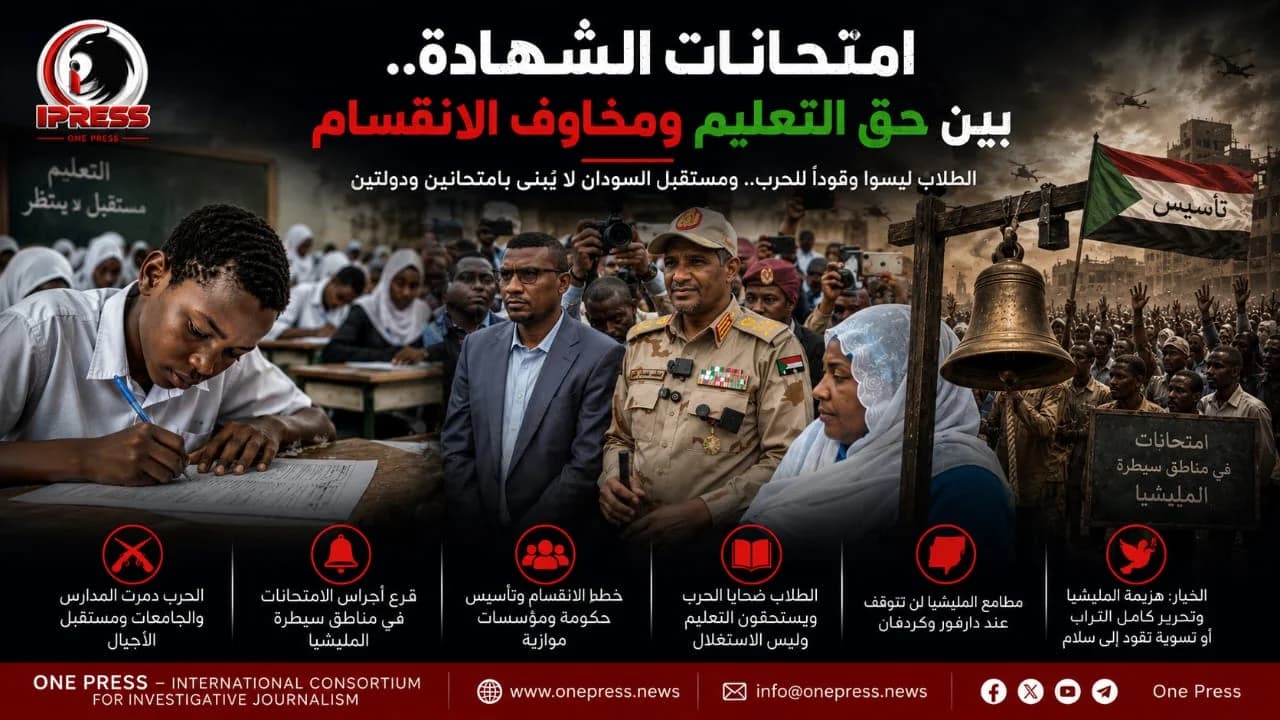
But today's scene looks more complicated. In a number of areas under militia control, the bells were sounded to signal that students were sitting for certification exams, in a scene that attempted to dress as a state, while the militia commander appeared to speak of the very war unleashed by the greed for power and power struggles. Here the bell does not become a mere declaration of the beginning of an examination, but a dangerous political symbol, because it is sounded in a divided land, under the authority of a fait accompli, and in the absence of a single state that gives the certificate its legal and national meaning.
A number of activists and teachers condemned the move, some of whom saw it as a harbinger of Sudan’s split into two states, not only through a direct political declaration, but through parallel institutions: a parallel government, parallel exams, parallel administrations, and rhetoric that attempts to transform military control into civilian and educational legitimacy. The danger lies not in students sitting the exam, but in using the students’ suffering to create a new political reality.
The deeper question: What does it mean for areas, military divisions and administrative centers to fall to the militia? What does it mean to leave almost all the states of Darfur out of the authority of the central state, and then declare the presidency of a parallel government from within the region? These are not fleeting military facts, but indicators of a political project that wants to start from Darfur, then expand to Kordofan, and then negotiate over the whole of Sudan from the position of arms and not from the position of national will.
However, students should not pay for this division. Sitting down for any Sudanese student, whether in government or militia-controlled areas, must first be read from the angle of his right to education, not from the angle of who rings the bell. These students are victims of a war not decision makers, and their families are looking for a window of survival amid siege, fear and displacement. Saving their future is therefore a national duty, but without education becoming a political stamp on de facto power.
The militia, in our assessment, does not view Darfur and Kordofan as the final borders of its project. Who thinks it will be enough to establish a state in Darfur or part of Kordofan? Those who take up arms to reach power will not stop at the borders of a region, and those who build their project on expansion by force will continue to see each concession as the beginning of a larger concession. Treating these steps as “local actions” is only an incomplete and dangerous reading.
Sudan today faces two ways: defeating this project militarily and politically, liberating the entire national territory and restoring the institutions of one state, or reaching a real national settlement that leads to a just peace that does not equal arms and does not divide the country and does not grant any party the right to build a state within the state. To leave the country between two tests, two governments, two armies and two authorities, is not peace, but a declared postponement of the next explosion.
“Students remain the most innocent face in this cruel landscape. They are not asking for maps of control or statements of war, but for a seat, a book, an exam and a recognized certificate. Those who do not see the future of Sudan in the eyes of these students will only see in politics a spoil, and will only see in the homeland a divided land.
By: Awadullah Nowai – Director of OnePress Press