
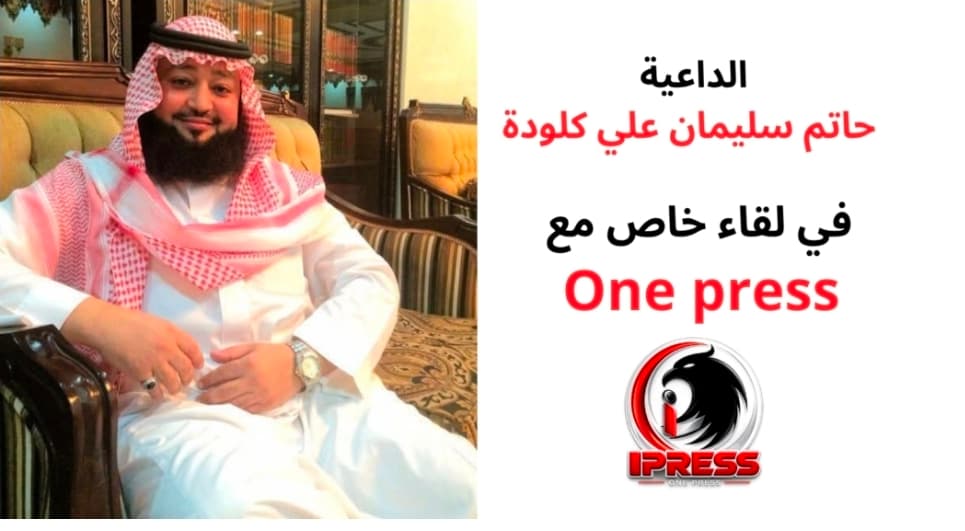
Hatem Kalouda: Content Industry is a Responsibility to Religion and the Nation
26 years in Saudi Arabia and over a million followers
Social media platforms are no longer just spaces for entertainment and content sharing, but they have turned into open spaces to form awareness and influence youth trends, which prompted Sudanese preacher Hatem Suleiman Ali Kalouda to go through his own experience via TikTok.
From Saudi Arabia, where he has lived for 26 years and works in the field of Quran memorization, Claude chose to address a wide audience with religious and social content, focusing on the issues of hijab, chastity and morality, as well as national messages related to Sudan and the repercussions of the war.
The number of followers to his account exceeded one million, in an experiment that he believes confirms the ability of content to reach the audience of digital platforms, when addressed in his language and within the tools he uses daily.
In this talk, Hatem Klouda talks about his transition from traditional advocacy work to digital content making, his relationship with Saudi society after more than a quarter of a century of residency, the role of the family and the content maker in guiding young people, as well as his vision of the responsibility of the Sudanese in presenting the image of their country through social media platforms..
Filed to:OnePress
«TikTok» It can be a space for advocacy and awareness
- Yeah. Let's start from the beginning. Who is Hatim Kalouda away from his image that followers know on TikTok?
I was born in Omdurman, and then moved with my family to Wad Madani at about the age of four, where my father worked as an engineer and manager for the Middle Region. I started my education at Sheikh Sharqiya Primary School, then middle school at Amiriya School, and then enrolled in Hantob High School. She later attended Omdurman Islamic University and studied civil engineering, then studied at the Faculty of Business Studies. As a professional, I am currently working in Saudi Arabia in the field of Dawa, specifically in schools memorizing the Holy Quran for men and women.
- Yeah. How did you move from studying civil engineering and business studies to preaching and memorizing the Holy Quran?
I currently work in Saudi Arabia in the field of advocacy, specifically in Koranic schools for men and women, which I have been practicing for a long time, in addition to my interest in religious awareness and guidance through social media.
- Yeah. I spent 26 years in Saudi Arabia. What did these years add to your experience?
I have lived in the Kingdom of Saudi Arabia for about twenty-six years, and my appearance in Saudi costume, Shamagh, came as a result of the long stay, work and friction with Saudi society, in addition to my love for this country, which I consider our second homeland, and has honorable attitudes towards Islamic countries in general and Sudan in particular. But my accent remains Sudanese, and my content does not hide our belonging to our homeland Sudan, but we remind him and commend his people on every occasion.
- Yeah. When did you feel that social media could be an extension of your message?
The beginning of my journey in the content industry began with a sense of duty to my Muslim brothers, especially the Sudanese, and a desire to be a platform for religious awareness and guidance, and spreading virtue and hijab and talking about ethics. I was also motivated by the negative content on the platform, so I wanted to have a presence, even a limited one, to meet it with useful content, although I did not expect this presence to reach what it reached.
Why did you choose TikTok specifically to deliver this type of content?
Because the platform has become a large space for attendance and interaction, especially among young people, I thought it important to have religious content and guidance in it, and to provide useful content through the means used by the audience itself.
- Yeah. Did you expect your account to reach more than 1 million followers?
I didn't expect this audience to get where it is. The beginning was based on the desire to provide useful content, and on a sense of responsibility towards Muslims and Sudanese, and then the experience evolved over time, and the followers and invitations of parents and relatives played a large role in the success of the platform.
- Yeah. What issues are you keen to highlight in the advocacy content?
We focus on religious awareness and guidance, spreading virtue and veiling and talking about ethics, as well as social issues that matter to people, and we strive for content to be meaningful and useful to followers.
- Yeah. Hijab is one of the topics that is repeated in your content.. How do you see the importance of bringing this issue across digital platforms?
The issues of hijab and legal cover are important social issues for Sudanese women and others, and are part of our duty as content makers and advocates. We talked about the veil over and over again, and we highlighted that it is a blessing, a covering, a chastity, and a gift from God to women. Many of the followers have responded to the hijab in its various forms, and the religious and guidance passages have had a clear impact on this.
- Yeah. Do you think TikTok tools can serve religious discourse rather than as a means of entertainment?
Yes, these platforms can be used to spread awareness, culture and science, and to learn the literature of dialogue and debate, and they can be used to spread virtue, ethics and awareness, instead of being a means of falling or harmful content.
- Yeah. How did Sudan enter your content so strongly, even though you have been living outside the country for many years?
My content does not hide our belonging to our homeland Sudan, but we remind him and commend his family on every occasion. With our social media presence and our closeness to young people, we are keen to highlight the national spirit, as well as religious and social issues.
- Yeah. In light of the war, how do you see the responsibility of the Sudanese content maker towards his homeland?
We are keen in our content to highlight the national spirit and clear support for the Sudanese Armed Forces in their defense of the land and show, and linking the community with its army, especially in times of adversity. The motto “One army, one people” was always present in our speech, and we were keen to raise the morale of the soldiers on the ground.
- Yeah. You talked about getting your messages to soldiers on the front lines. What does that mean to you?
We saw interaction from many soldiers, officers and commanders, who assured us that our voice reached them on the front lines, and this had a positive effect on the soldiers’ stability and progress.
- Yeah. It is often said that citizens have a role to play in protecting their country. How do you explain this responsibility?
The message that we seek to establish is that the citizen is the first man of security and the first line of defense, and that the security of the country is an integral part of the responsibility of the citizen. We have always stressed the need for the citizen to have a national awareness and a watchful eye, in order to preserve the security and capabilities of his country.
How did you build an interactive space dominated by positive speech?
I thank my followers who have played a big role in the success of the platform, and I believe that the secret of this success lies in the invitations of family and relatives. We have sought to highlight a moderate Sudanese environment that is free from racism, tribalism and hatred, and to spread the spirit of love and peace among all segments of society.
- Yeah. Have you encountered content based on racism or hate speech? How'd you handle it?
In many passages, we have rejected hate speech and socially divisive speech, and our followers have always urged positive speech.
- Yeah. In your experience, what are the most dangerous things young people face in everyday use of social media?
Social networking sites have become modern councils that have replaced traditional clubs and gatherings, especially for young people, and are inherently two-faced: positive and negative. I see it as a grace from God that should be thanked and used, and I hope that young people will use it to spread awareness, culture and science, and to learn the literature of dialogue and debate.
How can a young man differentiate between use that benefits him and use that hurts him?
There is a significant difference between negative follow-up and positive use; Negative follow-up is when one interacts with falling content by liking or sharing, thus contributing to the increase in its spread and followers. The positive use is that the follow-up is directed to the benefit of the individual and his community, and the dissemination of virtue, ethics, science and awareness, and away from what is harmful in religion and the world.
- Yeah. Where does the responsibility of the family begin to protect children from harmful content?
A: Parents have a great role in following their children and guiding them, education is a hard responsibility that requires an effort from parents to know what their children are watching and what they are following and who they are.
- Yeah. What should the family give to the children instead of simply denying them some content?
Parents should direct their children that these devices are a blessing to be thanked, and encourage them to programs of the Holy Quran, prophetic hadiths and other useful content.
- Yeah. With your daily presence on the platforms, how do you view the image of Sudan presented by some content makers?
Because of our presence in social media and our proximity to young people, we see – and our heart is pounding with pain and sadness as we say this – that many platforms unfortunately fight Islam and its people, and show a bad image of Sudan and its people, and carry hate speech and racism.
- Yeah. Do you see the negative image as the only one found in the Sudanese content?
There is no doubt that good exists. There are good platforms that call for tolerance, love and harmony, and spread virtue, veil, chastity and targeted religious passages, but there are few compared to Sudanese platforms, which are predominantly unconscious.
However, we thank God that these few are beginning to grow, that young men and women are becoming more aware, and that many of our daughters are committed to hijab and chastity.
- Yeah. What message do you send to the Sudanese content creator who wants his presence to be different?
I wish more for our country, our people and our youth, and that every Sudanese content maker is a responsible ambassador for his country on the TikTok platform.
At the end of this dialogue, what is your wish for Sudan and its people at this stage?
I pray to Allah to inspire us with our guidance, to reform our country and our state, to help our armed forces, to return our people to their homes safely in Darfur, Kordofan, Blue Nile and others, and to thwart the schemes of the enemies of Allah who are fighting Allah and His Messenger and fighting Islam and the people of Sudan, and to return their plots in their hearts.