
Port Sudan - Private
▫️Detailed reading on Omar Othman Al-Nameer companies and public money questions:-
In the world of banking, a disaster does not usually start out loud, but begins with a small signature below a request for financing, a recommendation within a credit committee, or an exception that passes quietly under the heading of a “strategic agent.” Years later, those signatures turn into huge numbers, distressed debts, and provisions that eat up depositors’ money and the state together.
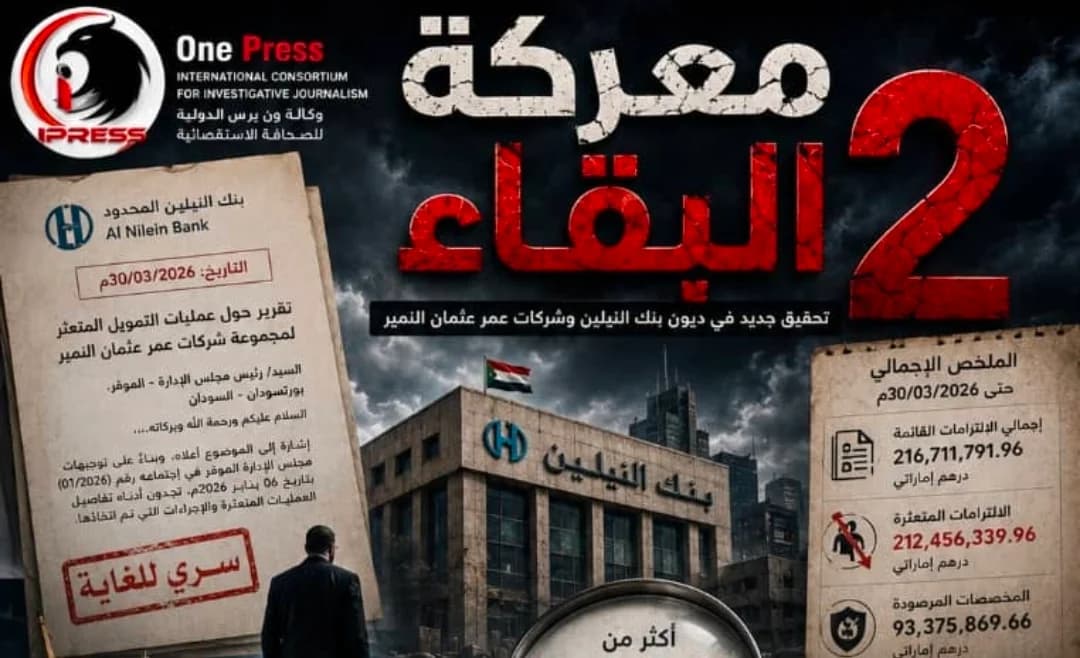
Internal documents obtained by OnePress reveal that the total outstanding liabilities of businessman Omar Othman Al Nemeir’s group of companies within Niles Bank as of March 30, 2026 amounted to more than AED 216.7 million, while non-performing liabilities alone exceeded AED 212.4 million, meaning that most of the portfolio is effectively within a near-total default cycle.
But the most serious question is not just about the size of the trip, but how to get there.
* How have the facilities continued to expand despite signs of stumbling since 2020?*
And who authorized the new funding despite the decline in repayment?
Were the risk and follow-up departments reporting the real issue, or was someone postponing the explosion?
The internal report reveals that AI Contractors alone accounted for more than AED 113.9 million in liabilities, of which more than AED 111.9 million were non-performing.
The bank admits in the report that the customer was regular until 2020, then payments gradually began to decline, however, the new facilities and funding continued.
Here the first heavy question marks appear.
If default indicators started in 2020, why was the client granted AED 20 million in cement financing in February 2023 through a documentary cycle?
Why was a new AED 22 million financing added to meet commitments with ADIB?*
Was the bank treating the default with additional funding?
Or was it an attempt to spin the crisis and postpone the admission of loss?
More seriously, the report cites existing commitments related to the so-called “Ethiopian Bank Project” worth close to 90 million dirhams.
What is the nature of this project?
Where are his cash flow documents?
*Was its economic feasibility subject to real review or was it treated as a guaranteed return project without actual realization?*
The same report confirms that the percentage of default within the company “Any Contracting Company” amounted to 98.30% of the total funding.
This is not a normal tumble rate within any banking institution, but rather an indicator of the near-total collapse of a company’s associated portfolio.
However, the percentage of coverage of allocations did not exceed 46.41%, which opens a sensitive banking question:
*Was the allocation below the required level compared to the actual risk?*
Was there an attempt to improve the bank’s book image by reducing provisions?
– Then comes Faiz Al Nu’am Petroleum Trading, which received more than AED 60.7 million in financing, while the non-performing liabilities amounted to more than AED 59.6 million.
According to the report, the funding was granted in December 2024 for the purpose of buying petroleum materials via the ship, but the customer took advantage of the entire funding ceiling without payment or rescheduling.
Here is a more complex question:
*How was it allowed to use a huge funding ceiling of this size without a cycle of tight control over the movement of funds and revenues?*
Was there a real follow-up to the goods and collections route?
Or was the bank just relying on promises and mortgages?
The report indicates the existence of future collections of the customer through the oil window of the Central Bank of Sudan worth about 31.2 million dirhams.
The professional question here is:
*If there are certain collections of this size, why not book them early for the bank before reaching the stage of full default?*
Who is behind in the decision of executive collection?
The report also reveals real estate mortgages within the UAE estimated at 23.95 million dirhams, in addition to a farm, axes and real estate in the neighborhood of Al-Raqqi in Sudan.
But the real value of the mortgages always remains the most serious question in bank default filings.
*Have these guarantees been assessed by independent and accredited bodies?*
*Is it still true of the values mentioned?*
Is it enough to cover existing liabilities after the decline in markets and price fluctuations?
The report recommended the possibility of settlement provided that the advance payment is at least 50%.
But the question that imposes itself strongly:
*If the customer is unable to pay from the start, where will a settlement provider of this size come from?*
Was the recommendation realistic or just an attempt to keep the file open without a final decision?
Transparency FZC is another example of the interlocking of guarantees and obligations within the same group.
The company obtained financing for the import of petroleum materials with the guarantee of the mortgages of the company “A.I. Contracting”, which means that the guarantees became cross between the companies associated with the same group.
Here is a very sensitive question:
Was the bank treating companies as truly independent entities?
Or was the entire group banked as a single file under the umbrella of one name and one influence?
The report also indicates that a settlement was concluded under the personal sponsorship of Mr. Omar Othman Al-Nameer, and was rescheduled with the approval of the Board of Directors, but the client subsequently failed to pay.
Here the question becomes more direct:
How many times have I been rescheduled?
And who would have recommended approval each time?
Was the rescheduling based on actual repayment capacity or a desire to avoid a loss classification?
Some of these files have been moving between legal departments, advisers and the courts for years, while the value of the default has continued to escalate, posing a fundamental question about the effectiveness of the bank’s early warning systems.
Was it a credit management problem?
Or in surveillance?
Or influence?
Or in the absence of a decisive decision from the first moment?
In our professional assessment, the issue is no longer just a normal bank default file, but has turned into a real test of the transparency of the entire Sudanese banking sector, especially when it comes to a 100% state-owned bank, that is, the final losses are not borne by a private institution, but by public money directly or indirectly.
The bigger question hangs over all these numbers:
*How did more than AED 216 million get out of state-owned bank vaults, and then most of it came back as bad debts, without the financing machine stopping early?*
Awadullah Nowai – Director of OnePress