Port Sudan - Private
Scene 1: Starting from inside the safe.
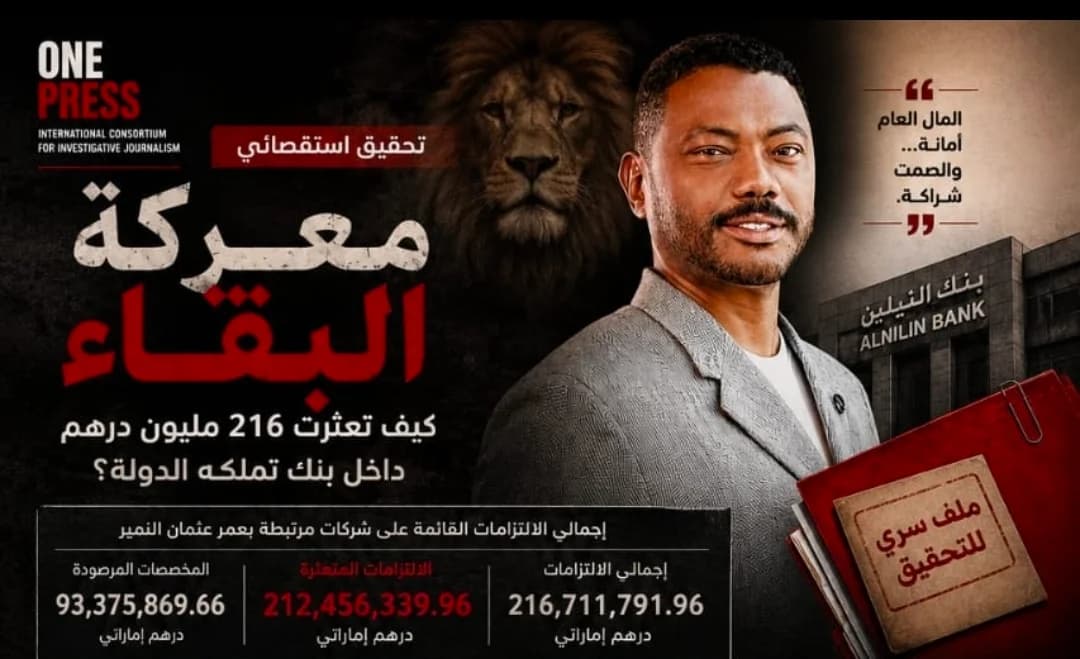
In the banking world, the numbers are always quiet. Arranged schedules, periodic reports, and financial boxes move silently inside computers and closed meeting rooms. But behind some numbers are more complicated stories. Stories that start with huge funding and end with heavy questions about public money, influence, and institutional silence. This investigation is based on internal banking documents, official correspondence, emails, and cross-referenced statements relating to the non-performing financing portfolio associated with businessman Omar Osman al-Nimair’s group of companies within the Bank of the Niles, a 100% state-owned bank in Sudan. The documents reveal that the total outstanding liabilities of companies linked to Al Namir amounted to AED 216,711,791.96, of which AED 212,456,339.96 were classified as non-performing debts, while the allocation was only AED 93,375,869.66. These numbers alone pose a serious question: how did this scale of default last for so many years within a government bank without a final resolution?
The documents indicate that the crisis was not a sudden accident or a passing loss, but a long path of financing, facilities, rescheduling and postponement, until the file turned over time to one of the largest issues of financial default associated with a single group of companies within a Sudanese government bank. In our estimation, the first serious sign of the case is the inflated amount of funding granted to a linked group without reaching a clear stopping point, which has created a high-risk financial concentration within a state-owned banking institution.
Scene 2: One company swallows the bulk
According to the internal report, SMMI Contracting alone has acquired more than AED 113 million, of which more than AED 111 million has become insolvent. This figure reveals a significant professional flaw in risk management, as almost all of the funding turned into a default, meaning that the credit rating was not up to par, or that the bank continued to grant facilities despite early signs of risk.
Al Naama General Trading Company’s liabilities amounted to more than AED 60 million, of which about AED 59 million were in default, while Al Naama General Trading Company showed almost complete default in all the funding granted to it. Usually, when companies start to default, banks tighten controls, reduce facilities or activate guarantees, but the documents indicate that the file lasted for many years without decisive action, which opens a direct question about the reason for the delay in collection, and whether there were pressures or special considerations that disrupted the implementation of legal procedures in full.
Scene 3: Guarantee Errors and Rescheduling
One of the most serious points that appear in the file is the nature of the guarantees provided in exchange for funds. The report points to mortgages, real estate, land and farms, but continuing to stumble on this scale raises a crucial professional question: were these guarantees of real value and monetizability? Or were they paper collaterals larger than their actual value?
In our estimation, one fundamental mistake has been the repeated reliance on rescheduling as a permanent solution rather than early resolution. Rescheduling, if repeated without real processing, becomes practically a means of postponing recognition of a loss, not a refund. This is evident in the file, where the bank has been circling for years between correspondence, recommendations and settlements without reaching a final conclusion.
Scene 4: Speech of Influence
Amid the documents, an e-mail sent by Omar Othman al-Nimair to the board of directors and executive management of the bank appeared, which carried very clear escalation language. In the letter, he spoke about opening “strict legal procedures” within Sudan and the UAE, and hinted that he had information about irregularities within the bank, and said a text that he “knows every little and big inside the bank,” and vowed to open “issues that you can’t accept.”
This letter reveals another aspect of the issue, related to the way conflict is managed within the file. Instead of a banking and legal debate over payment and settlements, the language of threats, threats, and threats of influence has entered the mainstream.
In our estimation, this is a very serious mistake, because the use of pressure and intimidation language in financial files creates an atmosphere of fear within organizations, and causes employees to hesitate to approach sensitive files or raise professional notes related to them.
Episode 5: Fear in the Bank
According to testimony obtained by OnePress, approaching Omar al-Nameer’s file inside the bank was uncomfortable for many employees. Some staff members have reportedly avoided giving any information or comment on the file for fear of clashing with the complex network of interests and pressures that have surrounded the case over the past years.
Another mistake, no less serious than the financial default itself, is the transformation of the institution from a regulatory environment to an environment of fear. When an employee is afraid to ask, review, or take notes, mistakes become repeatable, and public money becomes more vulnerable to influence and interpersonal relationships.
Scene 6: When the threats reached the press
As OnePress began working on the investigation, pressure began to shift outside the bank as well. According to the reports and available data, the Agency’s investigators were subjected to a series of direct and indirect threats, including statements, intimidation, escalation and attempts to intimidate the press team and prevent it from continuing the investigation.
The Agency also confirms that its Director General was directly attacked within the Port Sudan market by an individual associated with the case, following the start of the collection of information on non-performing funds, which prompted the Agency to open a criminal report under Article 144, while legal proceedings are still ongoing.
In our estimation, the most dangerous thing in the case is not only the amount of bad money, but the transfer of the climate of intimidation from inside the banking institution outside, to reach the national press itself, in an attempt to silence any investigative effort approaching the files of public money.
Scene 7: Public money doesn't disappear all at once.
Public money is not usually lost through one huge operation, but is slowly eroded. It starts with big funding, then rescheduling, then postponing collection, then a long administrative silence, until the number eventually turns into a “tumble” inside a bank report.
But behind the word “tumble” are bigger questions: who gave the funding? Who's watching? Who's late for collection? And who allowed more than 212 million dirhams to remain outside the treasury of a bank owned by the Sudanese state all these years?
This investigation does not provide final judgments, but it puts the numbers, messages, and facts before the public opinion, because a case of this magnitude does not concern only a faltering client, but the concept of oversight and accountability within state institutions itself.
OnePress – International Consortium for Investigative Journalism
Awadullah Nowai – Director of OnePress