Written by: Awadullah Nawai
Director of OnePress Agency for Investigative Journalism and Media
Entrance
There are cities that we pass through, and there are cities that leave something of their spirit in us before we leave.
If Tangier had opened the doors of legend and history to me, Casablanca was the last stop that gathered all the threads of the journey into one painting; The sea and history, the family and the homeland, the mosque and the city, the people who give the place its true meaning.
Here, on the shores of the Atlantic, I realized that great cities are not measured by the number of their buildings or the size of their economies, but by the unforgettable human impact they leave in the memory of their visitors.
Casablanca is not just the economic capital of the Kingdom of Morocco, it is a city made of the sea. A city that has risen from its port to become the heart of Morocco with its vibrant movement, trade and culture. Between its modern neighborhoods and old markets, the visitor discovers a city that combines originality and renewal without losing its identity.
But what is most striking in Casablanca is not its age, but its people. That unique combination of simplicity, generosity, openness and pride in home.
Hassan II Mosque. Where the stone meets the sea and the sky
On this journey I had to stand before one of the greatest architectural guides in the Muslim world; Hassan II Mosque.
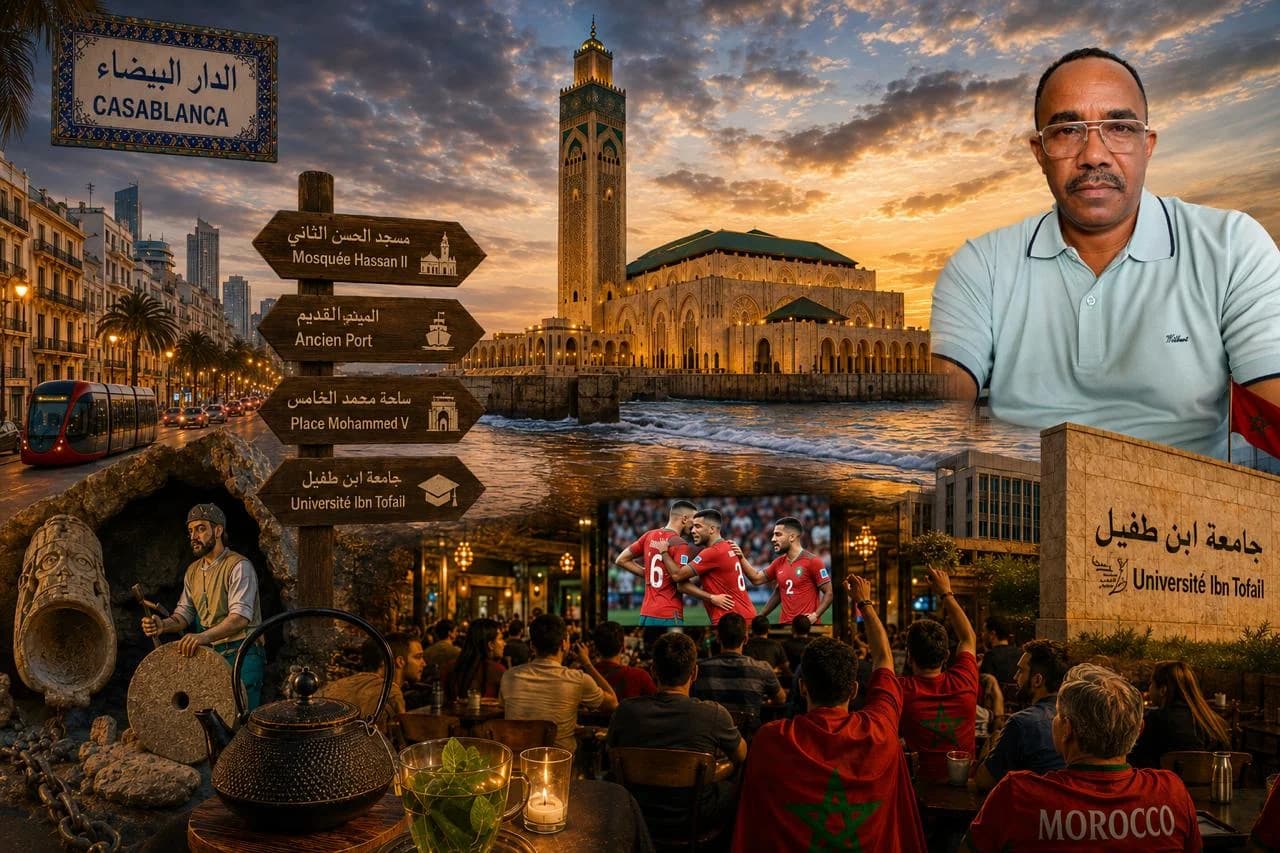
At sunset, the mosque appeared to emerge from the womb of the Atlantic Ocean, caught between the cloudy blues of the sky and the evening lights reflected on its white marble walls. The giant minaret rose like a finger pointing to the sky, while Moroccan arches and motifs looked like open pages from a long history of civilizational creativity.
The mosque is not just a religious landmark, but a Moroccan letter written in stone. Since its opening in 1993, it has been a testament to man’s ability to transform faith and beauty into timeless architectural work.
In those quiet moments, as the waves of the Atlantic hit the rocks below the mosque, I felt that the place was not only seen with the eye, but lived with the heart.
There are places we visit to take pictures of, and there are places she takes a picture of us in her memory.
The Hassan II Mosque was one of those places.
A family made the warmth of the journey.
This trip was not only a place trip, but also a humanitarian and family trip with distinction.
My wife, Lamia Hariri, accompanied me from the beginning of the trip from Kigali to Morocco, and was my partner in discovering the cities, people and small details that make travel beautiful.
In Morocco, I found myself in the midst of a generous family that embodied the most beautiful bonding, love and loyalty I knew about Moroccan society.
My sincere thanks and appreciation go to Mr. Abdul Rahim Hariri, to Mrs. Rabia Shaker, to Dr. Dunia Hariri, to Hiba Hariri and to Abdul Majid Hariri, who surrounded us with sincere affection and genuine generosity that made us feel that we are among our people and not in a country we are visiting for the first time.
These days have been a practical lesson in the meaning of family, when welcome is transformed into love, hospitality into a human relationship that is long remembered.
Kenitra. Science City
One of the beautiful stations that will remain in memory is our visit to the University of Quneitra with Dr. Dunya Hariri.
There I saw another face of modern Morocco; A face that shapes its future with science and knowledge. The university appeared to be an academic space that reflected Morocco’s investment in higher education and scientific research, and embodied the ambition of a new generation looking to the future with confidence.
After all, universities are not just buildings and classrooms; they are factories of ideas, dreams, and development projects to come.
In a small cafe. I saw Morocco.
But the scene that will remain closest to my heart was not in a university nor in a historical landmark.
He was in a cafe in central Casablanca.
There I sat with my wife watching a match for the Moroccan national team, while the venue was filled with men and women of all ages.
The screens were showing the game, but the eyes were showing something bigger than football.
I have seen people who love their country.
I saw the Moroccans living every minute of the game as if they were inside the stadium. Cheers rise with each attack, smiles widen with each beautiful touch of the ball, and silence reigns at moments of anticipation.
It wasn't just encouragement for a national team.
It was an expression of a deep belonging to a nation that was able to make football a unifying language among its children.
In that cafH, between the hot cups of tea and the smell of Moroccan mint that fills the place, I realized that the secret of Morocco’s strength lies not only in its history, economy or tourist attractions, but in the sincere love that Moroccans have for their homeland.
Love is reflected in their respect for their symbols.
Proud of their history.
behind their national team.
And in their ability to turn a football match into a celebration of identity and belonging.
The End of the Journey
As the departure time approached, Casablanca seemed to shorten the entire journey.
A city facing the sea with confidence.
A mosque hugs the sky.
A family lovingly embraced us.
A university creates the future.
People love their country with everything in it.
I left Casablanca, but I left something behind, and I took more from it than I expected.
So maybe the end of journeys is not the moment of departure, but the moment we realize that some cities are turning from just a stop on the road to part of our personal memory.
For me, Casablanca is more than a city.
It will remain a beautiful conclusion to a journey that began in Kigali and ended at the Atlantic, but will remain open in the heart as long as the memory retains the images of the sea, the lights of the mosque, and the faces of good people.