In the far north of Morocco, where the Mediterranean Sea meets the Atlantic Ocean, Tangier stands as a city with no resemblance to cities. For centuries it has been a gateway between Africa and Europe, a gateway for traders, travelers, diplomats, adventurers and artists. A city that has crossed over its land with multiple civilizations, each of which has left an impact on its age, culture and memory. Here, the legend juxtaposes with history, and the place turns into an open book whose pages tell the tales of humans, seas and mountains.
Since Tangier became the diplomatic capital of the Kingdom of Morocco during the 17th century, it has attracted foreign delegations, merchants and intellectuals, gradually becoming an international city with a unique political, economic and cultural status. Throughout the 19th century and the beginning of the 20th century, the city was the scene of events that made up an important aspect of modern Moroccan history, and its monuments are still present in its monuments, streets and palaces.
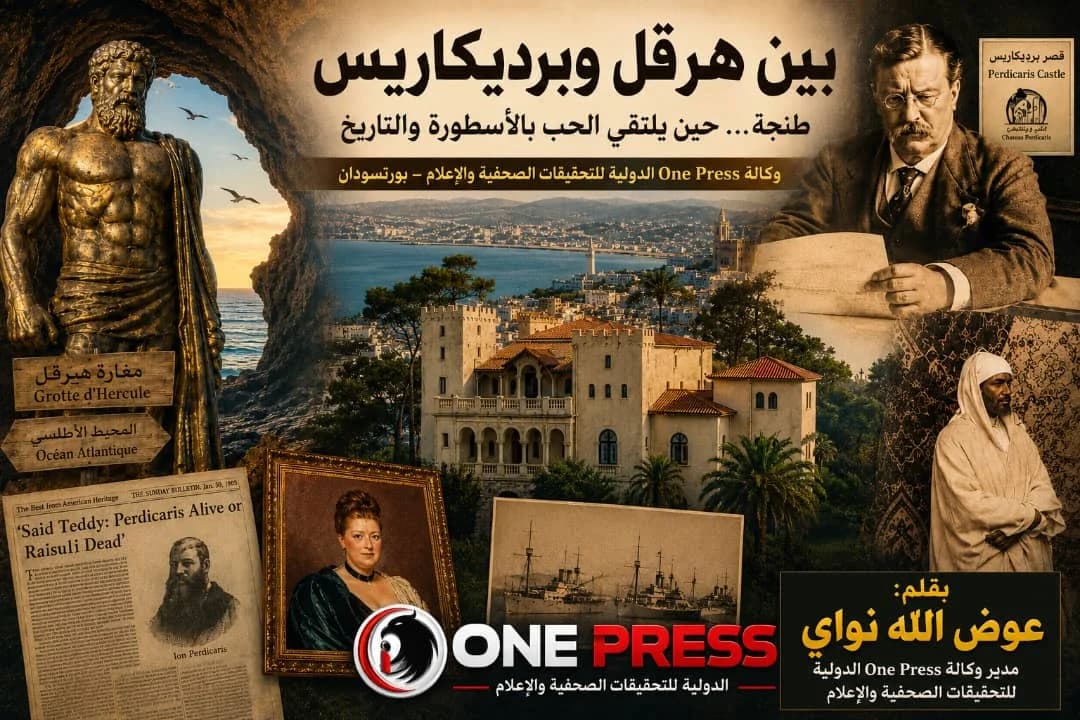
In this city two completely different tales begin, but they meet at one thought; Searching for immortality. The first belongs to the world of legend and is represented by the figure of Hercules, and the second belongs to the world of history and is represented by the figure of the American diplomat Ion Perdicaris.
At the cave of Hercules, where giant rocks open up on the Atlantic Ocean, generations pass on the account of the Greek hero who arrived on this earth after a series of supernatural adventures. Legend has it that he rested in the cave after completing one of his famous tasks, and that he cut parts of the mountain with his giant hands. Over time, the cave became a symbol of the search for power, survival and victory over death. Hercules was not just a mythical hero, he was the embodiment of the old man's dream of overcoming annihilation.
That’s why people weave endless stories of hidden treasures, magical stones and secrets buried deep in the rocks. Myths and superstitions were multiplying as man approached the unknown, and the cave became part of Tangier's popular memory, and a destination for those seeking tales before it became a tourist landmark.
But just a short walk from the cave, and in the heart of the Rumailat forest overlooking the Strait of Gibraltar, a whole different story begins. Here the hero was not looking for eternity, but for life itself.
In 1878, the Greek-American diplomat Ion Perdicaris built his famous mansion in the middle of the forest, having purchased large tracts of land surrounding it. The project was not just a luxury residence or real estate investment, it was a project of love and humanity. His wife Ellen was suffering from asthma, and he believed that fresh air and plant-rich nature could help ease her suffering.
This is why Perdicaris began to attract different types of trees and plants from several continents. Eucalyptus, camphor, pine and rare Mediterranean and tropical trees have been planted, transforming the rumilat into one of the most important ecological spaces in northern Morocco. The importance of the project is not limited to plants alone, but the region has become a haven for dozens of migratory bird species that cross the Strait of Gibraltar annually between Europe and Africa.
Man was fond of nature and the arts at the same time. Besides his diplomatic work, he was a painter and highly artistic. The paintings displayed in the palace attest to an important aspect of his character; He painted his wife Ellen, painted Moroccan figures, horses and scenes from the local environment, and created a self-portrait that is still preserved in the heritage holdings associated with his name. He loved Tangier not as a workstation, but as a second home.
From the balconies of the palace lay one of the most beautiful natural paintings in Morocco. A dense forest that flows towards the sea, ships that cross the strait, migratory birds that chart their paths in the sky, and an international city that comes to life at the crossroads of continents.
However, the calm of the palace did not last long.
In 1904, Sharif Ahmed Raissouni's men stormed the palace and kidnapped Perdicaris and his father, Cromwell Farley. Within hours Tangier became the focus of world attention, the issue made international headlines, and became the talk of political circles in Europe and America.
U.S. President Theodore Roosevelt personally pursued the case, and the United States sent its battleships to the Moroccan coasts to press for the release of the hijackers. A political crisis arose between Washington and Moroccan Sultan Moulay Abdelaziz, until the kidnapping became one of the most famous diplomatic crises of the early 20th century.
From that crisis came the phrase immortalized by history: “Perdicaris is alive or Raissouni is dead.” A phrase used in American political discourse and turned into an election slogan for President Roosevelt in his then-election campaign.
But the irony is that the relationship between the two men was not the image painted by the newspapers. Some historical documents suggest that Perdicaris came up with a different impression than his captor. He saw him as a man of strong character and complex political motivations, not merely an outlaw. Some accounts even later convey his admiration for Raissouni’s courage and his understanding of the nature of the conflict he was in.
The crisis ended with the release of Perdicaris, but it did not end with the memory of history. The issue has become the subject of books, studies and films, most notably the 1975 film “The Lion and the Wind” with the participation of international actor Sean Connery, inspired by the events of the kidnapping, although it has given it a lot of cinematic imagination.
Today, the Palace of Perdicaris stands as a witness to all these transformations. It is not just an archaeological building, but an open record that preserves the love story that drove its owner to build the palace, the story of the environment that made the Rumailat a unique forest, the story of kidnapping that shook international relations, and the story of a city that has always been a meeting place for legends and history.
When the visitor wanders among the rummel trees or stands in front of the grotto associated with the name Hercules, he discovers that Tangier does not tell a single story. It is a city that combines imagination and reality, between myth and document, between a man who dreamed of immortality through power, and a man who found his immortality in love, beauty and memory.
Between Hercules and Perdicaris is a long time, but Tangier combined them in one scene. The first left a myth passed down through generations, and the second left a forest, a palace, paintings, and a love story still present more than a century later. The city itself continues to tell the story of everyone who passes between the sea and the mountain, and listens well to the voice of history.