In Sudan, the word “mulana” is not stipulated in constitutions or laws, there is no provision in the Criminal Procedure Law or the Judicial Authority Law that defines a judge, nor a prosecutor, but it is a word that has settled in the Sudanese conscience until it became part of the prestige of justice itself.
“People say: MallOur Lord the Judge’ and MallOur Lord the Prosecutor’, as if society gave the people of the law a moral title before giving them a functional one.
The origin of the word may be attributed to “people of faith,” because the judge and the prosecutor are not merely officials of a state, but trustees of rights, blood, and freedoms.
The Public Prosecution in Sudan was not born as a passing institution, but originated with the formation of the modern state itself. From the beginnings of the administration of justice in the bilateral era, criminal prosecution was part of the system of government, before the prosecution later developed as an independent institution that would initiate criminal proceedings in the name of society.
The prosecution has served for decades as the first gateway to justice, receiving complaints, investigating, deciding, keeping, and bringing people to court. That is why prosecutors in the Sudanese consciousness have remained more like “guardians of law” than mere administrators within state offices.
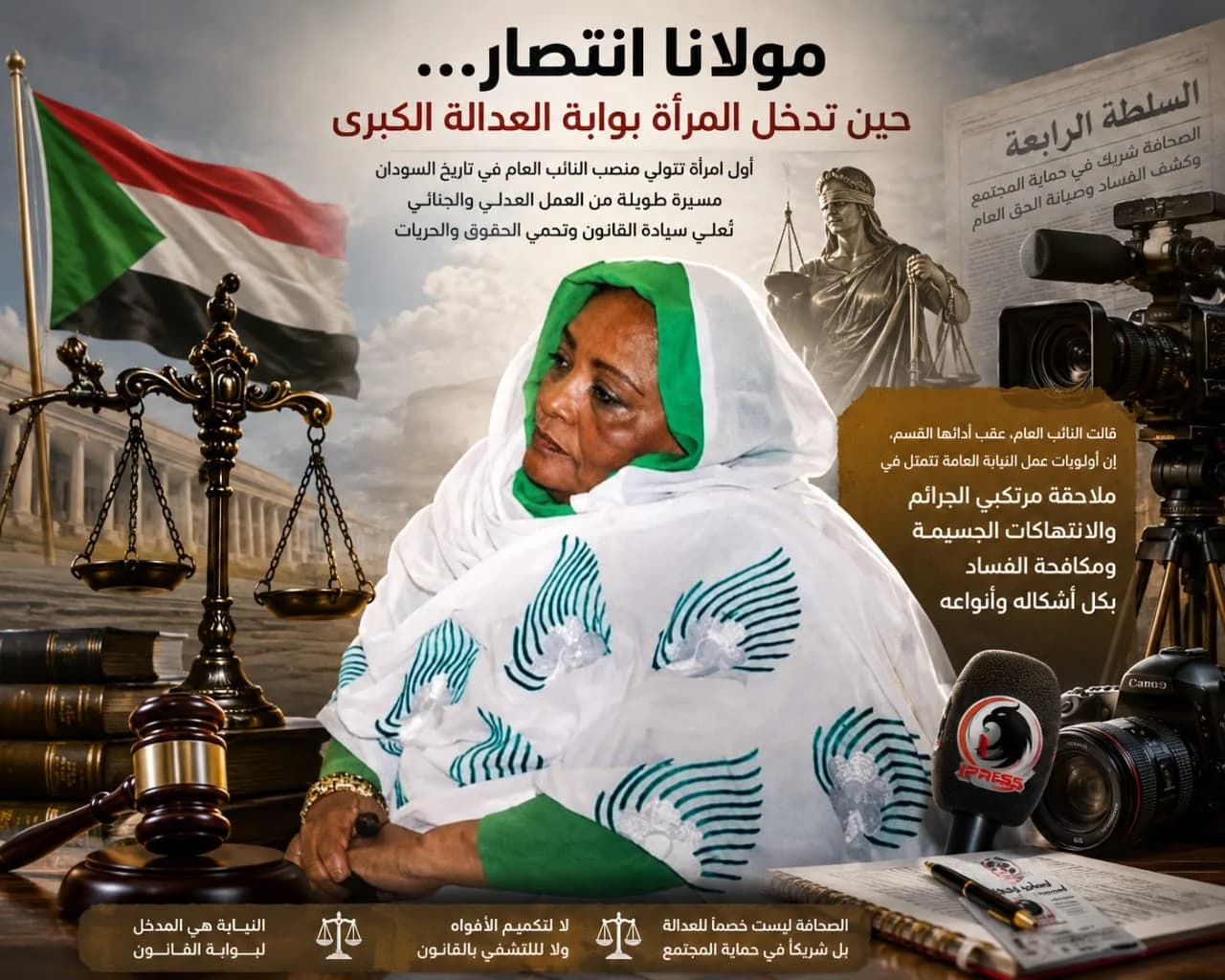
From this long and complex institution came the name of Maulana Intisar Ahmed Abdel Aal, who announced her appointment as Attorney General of the Republic of Sudan, in a step that is the first of its kind in the history of the country, becoming the first woman to take up this position since the establishment of the modern Sudanese state.
The appointment in itself is not just a protocol event, but a symbolic moment in the history of Sudanese justice, because the position of the Attorney General is not a normal job, but the position that stands between the state and the citizen, between power and right, between law and revenge.
Following her swearing-in, Attorney General Maulana Intisar Ahmed Abdul-Aal said that the priorities of the Public Prosecution’s work in the next phase will be to prosecute the perpetrators of crimes and serious violations, as well as fighting corruption in all its forms and types.
It is a statement that seems ordinary, but in the reality of Sudan today it is like opening a heavy door that has been hidden for many years.
War-weary countries, contested by accusations, and stacked with files, no longer need slogans about justice as much as they do need justice to move.
Because when crimes accumulate without accountability, they change from individual facts to a general culture, and from an exception to something familiar.
Our Lord is not a name that suddenly landed on the scene.
She's the daughter of the same law firm.
▁Since... The Ministry of Justice and Public Prosecution has been in operation since 1988, and has been progressive in various locations until it became, according to seniority, the oldest member of the Public Prosecution.
She studied law at the University of Cairo, Khartoum branch, obtained a Bachelor of Law in 1985, then a Master of Private Law from the University of Juba, and completed the examination of the legal profession in 1986.
Work. have worked in sensitive and complex locations; From the Presidency of the Public Funds Violations Prosecution, to the Planning and Research Department, to the Supervision of Corruption and Murder Cases, to the Presidency of the Attorney General's Inspection Service.
These sites are made not by courtesy, but by heavy files, difficult decisions, and the ability to withstand political and societal pressure.
Because justice is not measured by gender but by competence, her appointment is widely welcomed within the legal and human rights community.
Not just because she’s a woman, but because she has a long career inside an institution that’s known for being one of the most complex and sensitive in the country.
“In our estimation, the real stake today is not only on the symbolism of the appointment, but on the ability of the Public Prosecution to regain the confidence of the people at a time when politics are intertwined with war, media rumors, and facts of chaos.
She has also participated in regional and international conferences and workshops on human rights, criminal investigations, extradition and the fight against corruption.
These experiences are essential in a world where crime is no longer just local, but cross-border, and related to money, technology, the media and organized groups.
But the bigger question isn't: who's the Attorney General?
Q: What do people want from the prosecution today?
People don’t want speeches about justice, they want justice that walks the earth.
They want a prosecution that does not move under the pressure of public opinion, and does not stop under the pressure of influence.
They want an institution that differentiates between hostility and justice, between criticism and crime, and between journalism and defamation.
Here the press enters the scene as the “fourth power.”
The press was not called in vain, but because it became a supervisory authority parallel to the three branches of government: executive, legislative, and judicial.
The journalist doesn't have the gun, but he does.
He doesn't own the prison, but he does have a revelation that he's meant to keep hidden.
Since the advent of modern journalism in Europe, Sudan has played a major role in shaping public awareness, exposing corruption, defending freedoms, and monitoring governments.
But the Sudanese press itself has paid a heavy price over the decades. Confiscations, suspensions, prosecutions, reports, economic pressures, and ceaseless cyberwarfare.
Today, the Sudanese journalist faces more complex challenges than ever before.
It operates amid a turbulent political environment, overlapping laws, open digital platforms, and rumors spreading faster than the truth itself.
Some journalists face reporting under computer laws simply for practicing journalism or publishing material related to public affairs.
“In our assessment, the next stage needs an in-depth review of the relationship between the prosecution and the press.
The prosecution is the gateway to the law, but the law itself must not become a tool for healing or silencing.
This is why law reform is required today:
Prevent the use of the press law as a tool for personal revenge.
Mode Establish clear safeguards to prevent reports from being used to exhaust journalists.
Distinguish between professional journalistic work and real cybercrime.
“In our judgment, any journalist who is proven to have a journalistic record and a clear professional practice should not be treated with the same standards as those applied to anonymous accounts or cyber-extortion campaigns.
Journalism is not an adversary of justice.
It is a partner in the protection of society, the detection of corruption, and the maintenance of public right.
The appointment of Maulana Intisar Ahmed Abdel Aal remains a defining moment, not only because she is the first woman to reach this position, but also because the position itself comes at one of Sudan’s most complex moments.
It will have heavy files, bigger questions than people, and challenges related to people’s trust in the law itself.
“Justice in times of war requires not only scripts, but courage, wisdom, and distance from all.
Port Sudan.
*Awadallah Nawaii – Director of OnePress Agency for Investigative Journalism*