
Analytical article: Port Sudan – Special Agency
The press was not born to be a platform for praise or an arena for settling scores, but arose as the eye of society open to power, money and influence. Ever since man has known the state, he has known the need to be watched, searched through its files, and asked the questions that others are afraid to ask. That is why journalism, especially investigative journalism, remains one of the most dangerous and sensitive professions, because it always moves in the area between truth and influence.
A journalistic investigation is not an angry opinion piece, nor an emotional publication, but a complete science with its own strict rules. It starts with the information, then the document, then the verification, then the right of reply, then the use of safe legal language. The journalist does not act as a sentencing judge or prosecutor who makes accusations, but rather as a fact-reporter who leaves the final assessment to the reader and the judiciary.
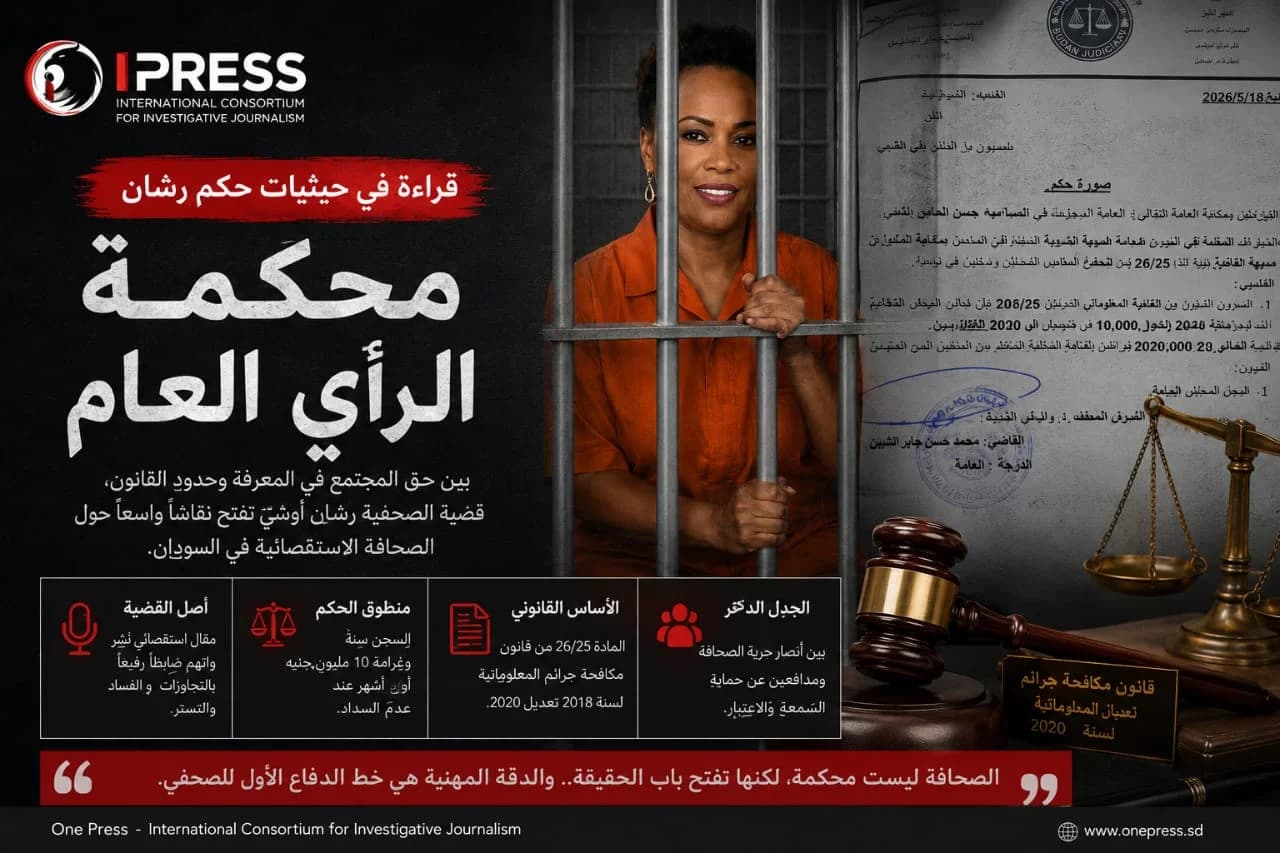
The sentence issued against journalist Rashan Oshi caused a large stir within the media and political circles, because the case went beyond the author to a larger question related to the limits of press freedom in Sudan, and the distance between the disclosure of corruption and falling under the laws of defamation and cybercrime.
According to the ruling issued by the Cybercrimes Court, the author was convicted under Article (25/26) of the Anti-Cybercrime Law of 2018 amending 2020, with a sentence of one year in prison and a fine. In the estimation of many, however, the case was not just a traditional legal dispute, but a complex confrontation between a society's right to know and the right of individuals to protect reputation and consideration.
The disputed article carried extremely serious charges against officials and officers, and used critical language such as “betrayal,” “corruption,” and “cover-up,” which are legally heavy descriptions, especially when published online. The Court, as appears from the operative part of the judgment, held that the text went beyond criticism and analysis to the level of direct attribution of criminal facts without published final court rulings supporting those charges.
On the other hand, a wide range of journalists believe that the issue is primarily about the right of the press to approach corruption files within public institutions, and that narrowing the space for investigative reporting may cause journalists to fear addressing issues of public interest. Others argue that the strength of the journalistic case does not come from the sharpness of the language, but from the strength of the document and the precision of the legal wording.
In the argument of public opinion, the case appeared to be a confrontation between two parties:
A writer says she uncovered facts of public interest, and a complainant who saw the article as having caused him serious moral and professional damage by publishing accusations against job and national honor. Between the two parties, the Court stood to rule not on political controversy, but on the manner of drafting and the limits of liability for electronic publication.
▪️The case brought back to the fore an old question within the editorial rooms: how does a journalist balance professional audacity with legal safety? Many powerful investigations are judicially dropped not because of poor information, but because of the way they are written. One definitive word may turn the investigation from a “journalistic revelation” to a “direct accusation,” and from “information under examination” to a “public condemnation.”
Modern schools of investigative journalism are based on a simple principle:
“Let the document speak, not the writer.”
Therefore, major professional institutions rely on the language of legal hedging such as: “according to documents”,
According to sources,
"Inquiries indicate,"
“No response could be received,”
Instead of assertive language that might be understood as final judgment.
“The press is nobody’s enemy, but it’s also not a court. Its mission is to open the door to truth, not to pass judgment on behalf of society. The closer a journalist comes to sensitive files, the more he needs accuracy, balance, and legal awareness.
Perhaps the most important recommendation of this case to fellow journalists is that investigative reporting is no longer just a talent for writing, but a science of its own, one that needs to be trained in:
Document management,
Right of reply,
Digital Safety,
Secure legal drafting.
A journalist with a pen without legal knowledge may lose his case even as he approaches the truth.
Awadullah Nowai – Director of OnePress