
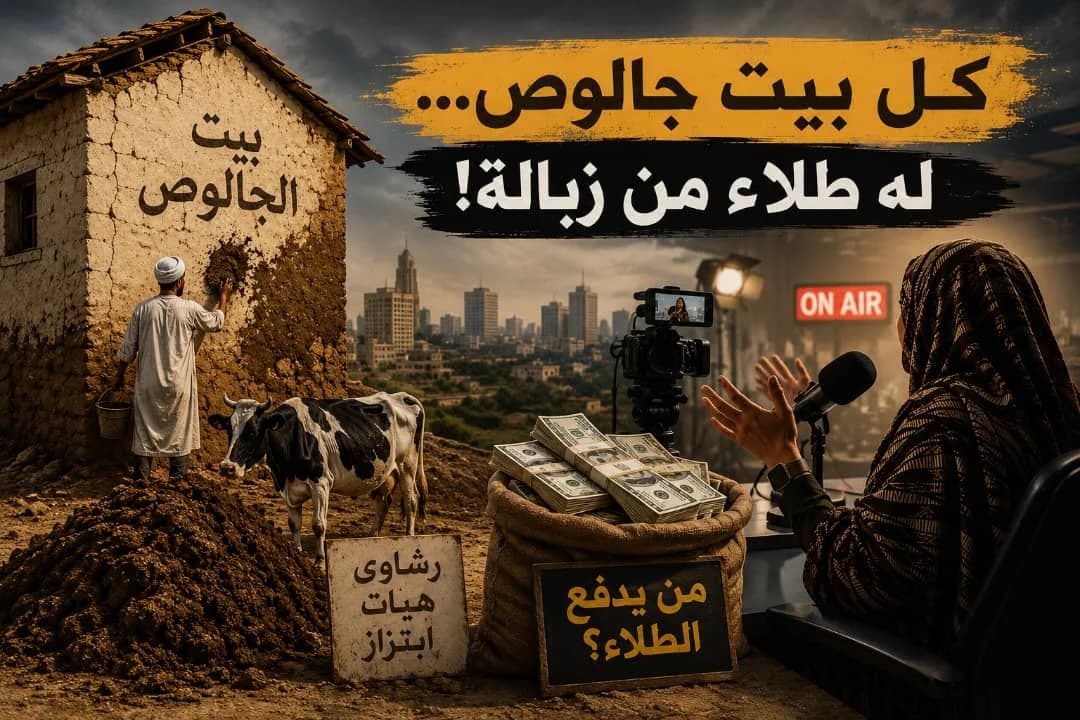
In ancient Sudanese drama, the choice of names was not in vain. For a real writer, a name is not a linguistic ornament, but a key to understanding the whole idea. Therefore came the series of the house of gallows entitled shocking and semantic together.
In Sudanese culture, the “stemming” is not just a mud house, but a house that needs permanent restoration, and frequent paint with cow dung to hide cracks and give the walls a shape that looks solid from the outside, while the truth inside is something else entirely.
This “paint” is not a real restoration, but a temporary beautification of a cracked house at any moment.
Therefore, the smart idea in the series seemed like a direct projection on the world of corruption, bribery and nepotism, where money, gifts and gifts are used as a new layer of "scum" to cover up old smells, and hide the moral cracks that ravage institutions, media and politics together.
The series, written by Dr. Ali Beldo and presented on Sudanese radio within the framework of the “Saiko Drama”, was not just a tale of a corrupt businessman trying to obliterate his past, but an attempt to read the human psyche when bribery turns into a lifestyle, and when it becomes easier to buy receivables than to face the truth.
In fact, the press itself has a lot of houses.
“There are journalists who don’t live by the profession, but by the wall. Whenever there's a scandal, the paint comes. Whenever corruption was exposed, the new “scumbag” came to cover the smell. As the wall cracked, a new financier emerged carrying another glass of paint.
Hence the question that people are asking these days:
Is the carcass... rented?
Of course, many laughed at the man who said his famous phrase about the “rented carcass”, and the sentence turned into an article of scarcity in the books, but amid laughter disappeared the most important question:
Who pays?
The program, which is presented on a daily or near-daily basis, is not broadcast over a rickety phone in a cramped room, and is not produced in an improvised “militarist’s lavat” manner, but is filmed inside a respected studio in the engineers, with a crew of photography, lighting, editing and directing, which are not managed by emotions or revolutionary slogans, but by bills.
People have the right to ask, without offending or offending:
What is the source of funding?
Transparency is required not only of the government official, but even of the journalist who puts himself at the position of the daily moral preacher of the people.
When a journalist turns into an open platform of accusation against everyone, he is also required to explain to the public how his platform is run, where the production budget comes from, who pays the studio rent, and who bears the full monthly cost.
Because the most dangerous type of journalism is not one that is biased... but one that hides its financiers behind the guise of “independence.”
The problem is not that there is a funder, even the largest media organizations in the world have funders and contributors, but the difference is that respected institutions clearly declare this, while some of our platforms are turning into a large “house of gallows”; Each period comes from painting it with a new layer so that cracks do not appear.
In Sudan, unfortunately, some media platforms no longer operate under the logic of “opinion and other opinion,” but rather under the logic of “pay... write.”
If the paint stops, the real wall comes back.
So the question will remain:
Is the car really rented?
Or is all we see just a misunderstanding?
The answer doesn’t take long speeches, no screaming on camera, no mutual swearing parties.
The answer is simple:
▁Clear. Clear financial transparency.
Open to public opinion.
Sources of funding revealed.
Otherwise, it will remain just a new layer of “sucking garbage” on an old wall whose owners fear it will fall.
Port Sudan
*Awadallah Nawaii – Director of OnePress Agency for Investigative Journalism*