
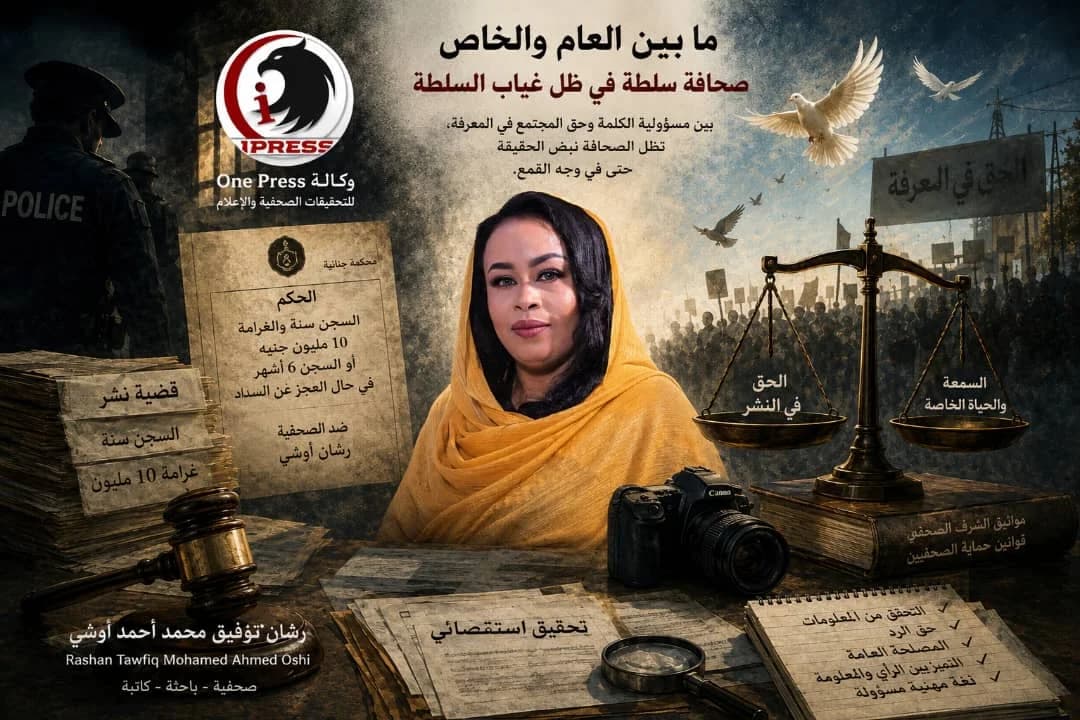
In countries where institutions are established, the press acts as the eye of society on power. In confused countries, where politics overlaps with security and interests with influence, journalism sometimes turns into an unwanted adversary, not because it lies, but because it asks. The question in turbulent environments may become more serious than the answer itself.
Since when did information become a crime?
Does a journalist work for his or her own good when he or she opens a public file about money, influence, or management?
Are everyone who writes an investigative report looking for a personal heroism, or are some journalists paying a professional and moral price for choosing to approach areas the PA does not want to approach?
In the Third World in particular, some systems view journalism not as a partner in building awareness, but as a constant nuisance. So you try to monitor them, scale them up, or push them toward “safe journalism” that doesn’t come close to sensitive files. Every unstable authority fears the free word, for the word reveals what the bureaucracy is trying to hide.
But the bigger question is:
Why do democracies protect journalism when closed systems fear it?
Because journalism in democratic countries is not just a profession, but part of the system of public control. There, the journalist is seen as a civilian observer who helps expose dysfunction, corruption, and mismanagement, not an adversary of the state. They have therefore established laws that balance freedom of publication and individual rights, so that the press does not become a mess, and power does not become a guillotine.
In this context, the role of journalists’ associations and international professional organizations has emerged, which defend not so much individuals as the principle itself: the right of access to information, the right of responsible publication, and the refusal to use custodial sanctions to intimidate journalists.
The Global Investigative Journalism Network, an international organization of hundreds of investigative journalism organizations around the world, aims to support journalists in training, legal protection, exchange of expertise and cross-border investigations. This network arose because investigative journalists often work alone in the face of vast influence, while the truth sometimes needs an international umbrella to protect it from isolation and pressure.
These organizations do not grant the journalist immunity against wrongdoing, but they defend his right to search and investigate, and demand that the issues of publication be within the civil and professional framework, not criminal, as long as the publication does not turn into direct incitement or deliberate falsification or explicit violation of the law.
In Sudan, the controversy has resurfaced after the sentencing of journalist Rashan Oshi, who was sentenced to one year in prison with a fine of 10 million pounds, or six months in prison in case of non-payment, for an article dealing with corruption charges against a police officer working at the Sudanese embassy in Egypt.
The case opened a wide door for discussion:
Does a criminal sentence against a journalist lead to the downfall of his professional status? Or does he sometimes raise his stock amid those who see the real press paying high prices?
The answer is neither emotional nor absolute. Not every journalist is a hero, not every court ruling is a target of freedom. But professional societies always look at the nature of the issue itself:
Was the publication based on information and documents?
Has the other party been given the right of reply?
Have you used direct accusatory language or professional language based on statutory reservation?
Was the goal to serve the public interest or settle accounts?
“True investigative journalism does not mean slander, and defending reputations does not mean stifling journalism. Between the two, there is a very delicate area that requires high professionalism, legal expertise and moral awareness.
Therefore, a professional journalist does not write in the language of categorical condemnation, but in the language of professional probability and continuous verification. Uses phrases such as:
“According to the documents available,”
"According to the newspaper,
“In our professional judgment,”
“The facts raise questions.”
"According to informed sources,"
They are not used to escape, but to balance copyright and the rights of others.
Professional investigation always requires:
verification of documents,
Review the dates,
The difference between opinion and information,
Right of reply,
The accusation is not based on suspicion.
Stay away from emotional or personal language.
A journalist is not a judge who makes judgments, nor an activist who writes in anger, but a seeker of truth in a space full of legal, political, and moral mines.
Ultimately, journalism remains one of the most complex professions in troubled societies. They are required to expose corruption without falling into defamation, to defend society without becoming an instrument of conflict, to approach power without dependence on it, and to approach people without trading in their pain.
This is why the real battle may not be between the press and power, but between the press itself and the temptations of haste, revenge, passion, and the desire to make noise instead of truth.
Awadullah Nowai – Director of OnePress
Port Sudan – May 2026