
Port Sudan – OnePress
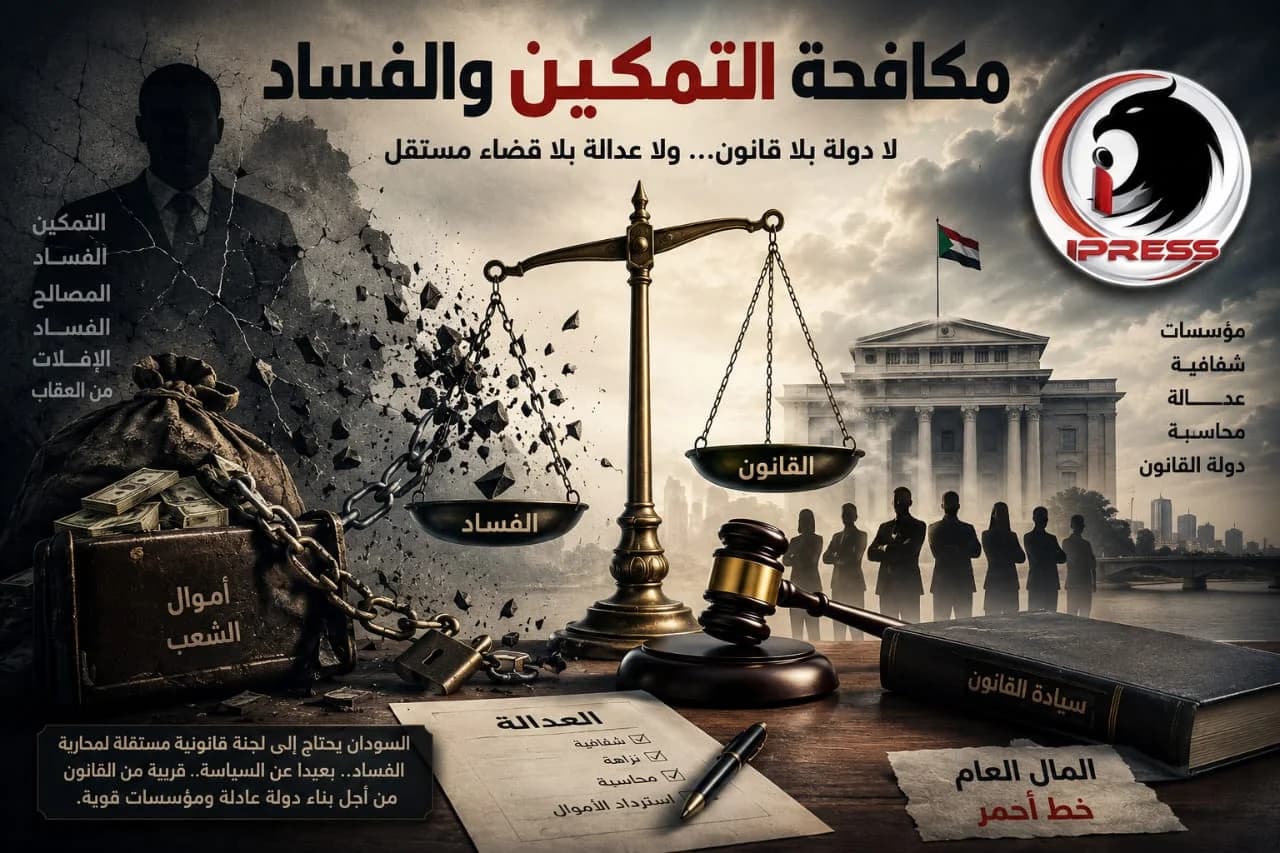
When regimes fall, states usually begin the quest for justice, but the real danger arises when justice itself becomes an arena for political conflict. In Sudan, the Commission for the Elimination of Empowerment, the Fight against Corruption and the Recovery of Public Funds came as one of the most controversial institutions after the fall of the rescue system, among those who saw it as a necessary tool to dismantle the structure of political and economic empowerment, and who considered it a wide door to bypass the law and weaken state institutions under the banner of the revolution.
▁Law The Deeming Commission Law, as a basic idea, was founded on removing the effects of the June 30, 1989, regime, recovering public funds, and ending partisan control over state institutions, the civil service, and the economy. The law gave the commission sweeping powers including forfeiture, termination of employment, revocation of appointments, freezing of assets, and review of companies, institutions, and economic fronts associated with the former regime. The philosophy on which the law was built was that the state could not be run by a one-party mentality or networks of interests that had monopolized influence and the economy for decades.
The real controversy, however, was not always about the legal texts themselves, but rather about the manner of application and the composition of the committee. Many have argued that the commission has at some point gone beyond the legal framework and turned into a political platform rather than a professional legal body. Broad questions were also raised about its membership, due to the predominance of political affiliations of some members and the weak institutional and legal balance within them, which made some decisions seem closer to political rivalry than to impartial investigation. In several cases, decisions to confiscate, dismiss or recover property were issued before normal judicial processes were completed, which opened the door to legal challenge and questioning of the integrity of the proceedings.
Despite all the political storms the country has experienced, the Sudanese judiciary remains one of the oldest and most prestigious national institutions in Sudan. For decades, the Sudanese judiciary has been associated with respected legal competencies that have built a legal reputation that has extended beyond borders, and a number of Sudanese judges have participated in regional and international institutions and judicial bodies. The judiciary has gone through complex stages of political pressure, but it has retained within its professional memory a well-established tradition of evidence, the right of defence, judicial gradualism and non-conviction outside the court arenas. Therefore, any real anti-corruption project cannot succeed through temporary committees alone, but through stable judicial institutions, independent courts, and professional prosecutors that work according to the law and not according to political slogans.
Today, in light of the war, the absence of the Legislative Council, the disruption of the Constitutional Court, and the decline of many institutions of oversight and accountability, the country seems to really need an integrated national legal project to combat corruption, which is not based on the spirit of political revenge or the mentality of counter-empowerment, but on building a permanent institutional justice system. Sudan needs an independent legal commission or commission to be established by a clear and specific law, subject to judicial oversight, and comprising judges, financial experts, legal reviewers, and representatives of the Public Prosecution, not political activists fighting media battles under the banner of fighting corruption.
Corruption in Sudan is no longer just an isolated financial transgression, but has turned into a complex and overlapping structure within the economy, civil service, government contracts, land, banking sector, ports and public resources. Facing this reality requires professional legal tools ranging from reviewing government contracts, tracking funds, strengthening review bodies, obliging institutions to be transparent, establishing specialized courts for corruption crimes, and rebuilding trust between the citizen and the state. The absence of the Parliament and the Constitutional Court also renders any exceptional authority liable to inaction if it is not regulated by law and judicial oversight.
▁More dangerous. The most dangerous thing that can happen to any state is that the anti-corruption slogan itself turns into a means to liquidate opponents or dismantle state institutions without building a real institutional alternative. Justice is not run by anger, and the state is not built by temporary committees, but by stable law and established institutions. In our opinion, Sudan today does not need a new version of political conflict under the banner of dismantling, but it needs to establish a real state of law, in which the judiciary is the government, and the Constitution is the reference, and public money is a red line not protected by slogans but by institutions.
Awadullah Nowai – Director of OnePress