
PORTSUDAN _ OnePress
There are people whose relationships are built on memory before politics, on people before governments, and on the race that mixed in ports, airports, and markets before crises were born and hubs formed. Sudanese have been part of the Emirati tale since the early days of the modern state; When the UAE was taking its first steps in management, education, engineering and services, al-Sudani was there: a teacher, a judge, a doctor, an officer, an engineer, an administrator, and an expert.
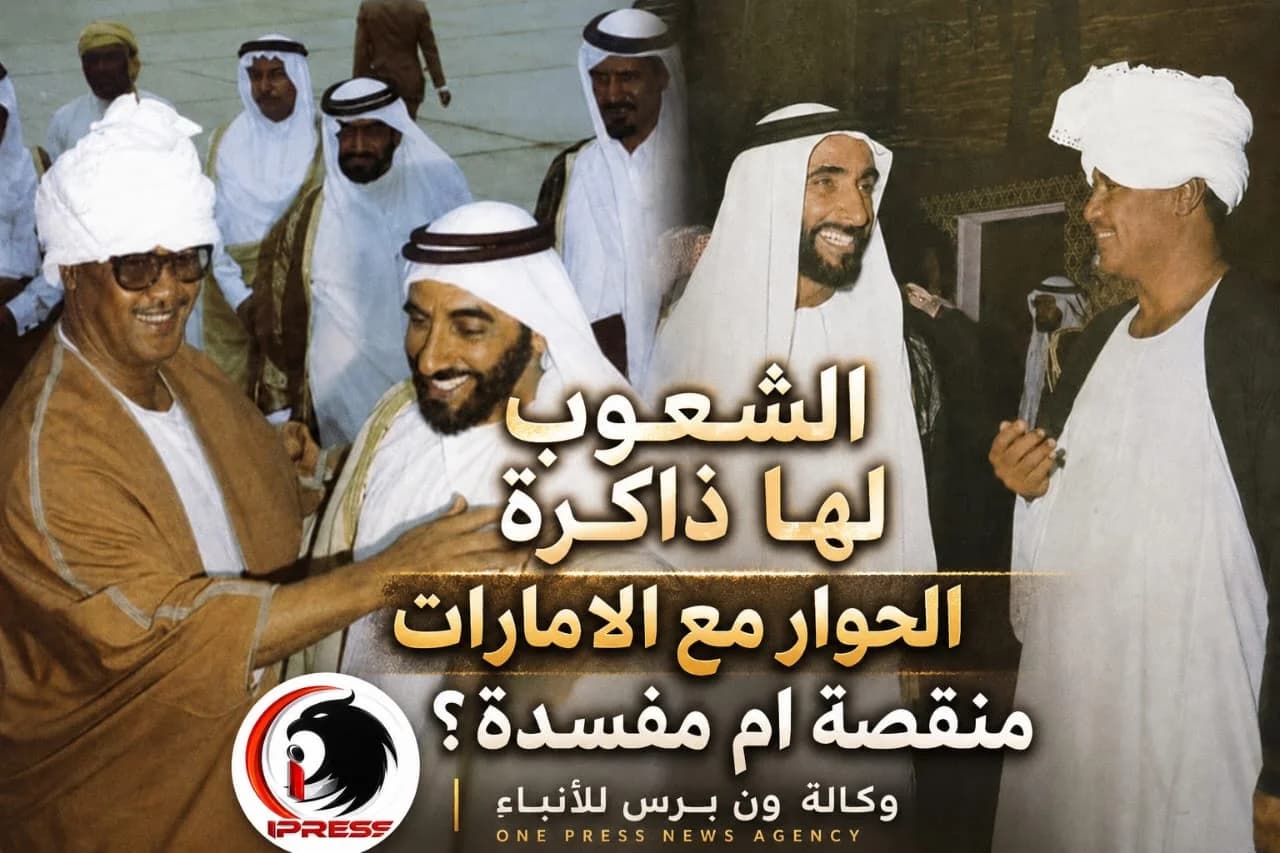
Under President Jaafar Nimeiri, the relationship between Khartoum and Abu Dhabi was not a seasonal one, but one of the warmest and most stable Arab relations, based on mutual respect and appreciation, and on a personal and political legacy between the Sudanese leadership and Sheikh Zayed bin Sultan Al Nahyan, a man who maintained a special affection towards Sudan and its people.
This is why the question today is more complex than just a passing political controversy:
Is the dialogue with the UAE lacking? Or is the absolute breakup the biggest spoiler?
▁* Scene 1: How are interstate interests constructed?
States are not governed by emotions alone, nor are their relationships built on love and hatred as the public imagines in moments of anger and emotion. International politics is a very cold world; A world where interests move before slogans, facts before wishes.
Do they love each other because they love each other?
Do you hate them because they hate each other?
If international relations were based on love, the United States would not talk to its adversaries, and countries that have fought wars for decades would not sit at the same table looking for gas, trade, and security agreements.
States talk because they want to protect their interests, prevent collapse, close the doors of chaos, or at least mitigate their losses.
The most serious question here is:
Does dialogue mean compromise?
Does sitting with an opponent mean surrendering to him with novelty and triumph?
▁Response The answer is no.
Dialogue is not always a sign of weakness, nor is silence always a hero. Sometimes dialogue is part of managing the conflict itself, not its end. Sometimes the table is used to achieve what the guns cannot, or to stabilize the outcome of the field politically and diplomatically.
Scene 2: Why is the Sudanese government talking to the UAE?
Since man was created, conflict has been a part of life. Even in the greatest scenes of insubordination and arrogance, dialogue remained as a universal principle for understanding situations, uncovering facts, and establishing argument.
The Qur'an itself presents one of the greatest scenes of the dialogue when he addressed the Almighty after being forced and arrogant and refused to prostrate himself to Adam. The dialogue was not a tribute to the devil, but an argument and a revelation of falsehood before creation and history.
Here is a distinction between two things:
Dialogue as a political tool to manage interests, and surrender as a concession of rights, blood, and sovereignty.
The Sudanese government today does not talk to the UAE for love of controversy or to escape the battle, but because it manages a complex file in which war, politics, the economy and regional and international relations overlap.
Sudan is not an island isolated from the world, and it cannot be managed by the logic of shouting alone, especially in light of a war that has drained the state, society and economy.
*Third scene:*
Dialogue must be based on the terms of reference and principles, the most important of which is non-interference in the affairs of their peoples, policies and laws governing the interests of their peoples in how to conduct their internal affairs and the transfer of power and how to put the two forces and legislation and their terms of reference. No party should enter into the details of others from political or ideological orientations, and the fight against extremist ideas with an extended impact should be discussed and not erased from the minds of people by killing and displacing them from their homes.
Extremism fights with dialogue and logic, not with the creation of a corresponding conflict.
Scene 4: Where is the real problem?
▁Do you? Is the problem between Sudan and the UAE a border dispute?
Oh, no.
Is there a land dispute between the two countries?
Oh, no.
Is there a historical enmity between the Sudanese people and the Emirati people?
Absolutely not.
So where is the crisis?
The real crisis is a crisis of visions, interests and political estimates, exacerbated within a large Sudanese vacuum, and within a state of sharp Sudanese political division that made the doors of the country open to all foreign interventions.
Is there an internal problem?
Yeah.
Is there a political divide, a power struggle, a narrative and a national project?
Yeah.
▁About External interventions cannot be isolated from internal division. When the National Front weakens, the country becomes an open arena for regional and international axes, organs, and interests.
Here, the Sudanese must have the courage to confess before distributing the accusations. A significant part of what has happened is a direct result of the failure of Sudanese elites to build a stable, balanced and just state, and not just a result of foreign plots alone.
▁Ring. Conclusion
▁There. There is an ancient legacy between Sheikh Zayed and the Sudanese people based on love, respect and mutual appreciation, and this legacy cannot be easily erased no matter how complicated the political files.
On the other hand, recent years have revealed the extent of the devastation wrought by political Islam groups and ideological movements that have run Sudan with a mentality of exclusion, empowerment and perpetual conflict.
These groups have corrupted the political sphere, hit state institutions, torn the national fabric, and opened the doors of Sudan to all forms of external intervention, so that the homeland itself has become an arena of regional and international conflict.
▁How? How do we fix what these groups have corrupted?
This is the real question that the Sudanese must be concerned with today.
What is happening in Sudan confirms that the Sudanese people and the armed forces and other supporting forces have managed to break the rebellion, and that the project of kidnapping the state by armed force faces widespread popular rejection.
In our assessment, any external role that has contributed to fuelling the war or supporting armed militias will continue to be condemned morally, politically and historically, and Sudanese memory will not easily erase images of blood, destruction and displacement.
Therefore, any dialogue with the UAE or with influential international powers cannot succeed unless it is based on clear foundations:
Respect the sovereignty of Sudan, stop supporting any armed groups, and not interfere in the Sudanese national decision.
At the same time, such dialogues should not be conducted in closed rooms away from Sudanese public opinion, because the people who paid the blood and the greatest price have the full right to know what is being managed in their name.
Building new relations with any regional or international axis cannot be achieved through ambiguous deals or ambiguous settlements, but through a strong, cohesive Sudanese state that knows its interests and protects its national decision from kidnapping again.
Awadullah Nowai – Director of OnePress