
Port Sudan - Private
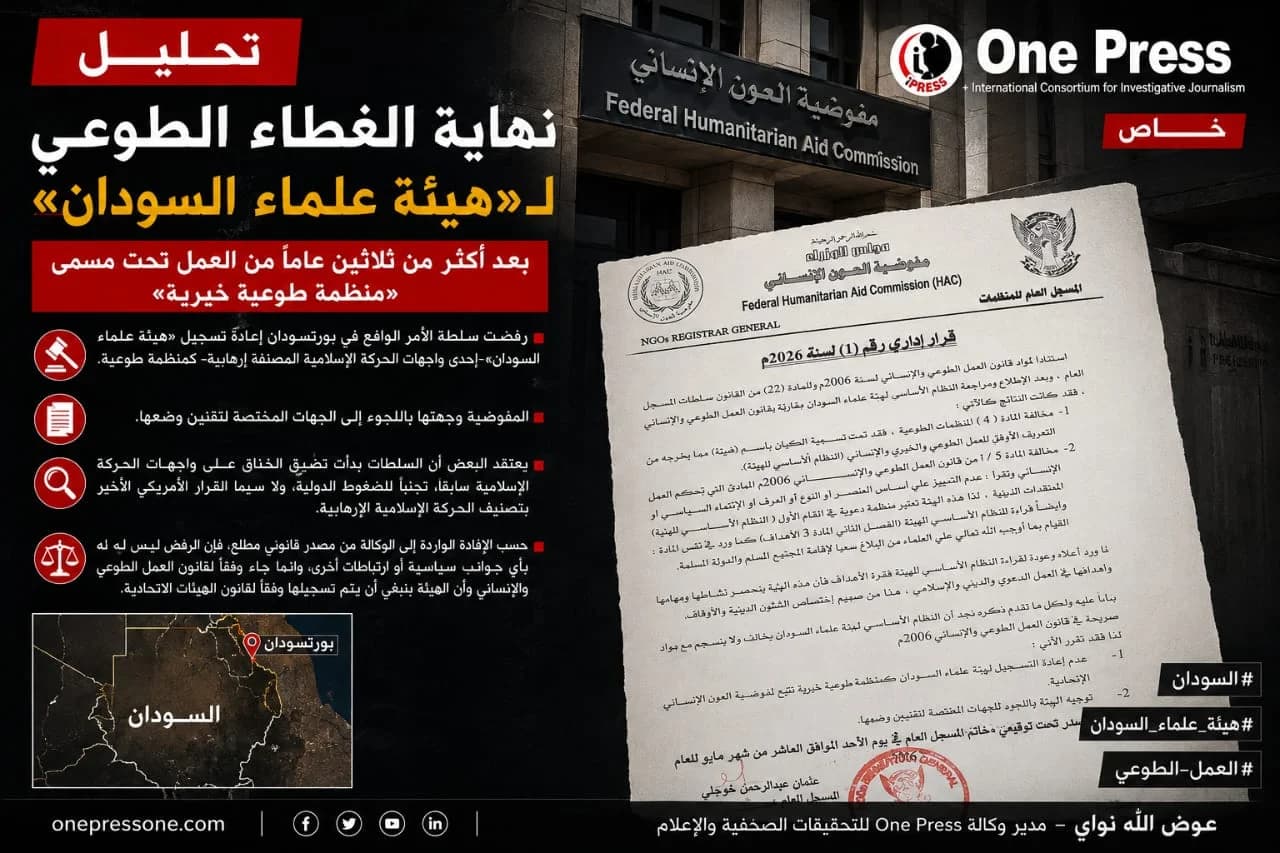
▁According to In stable countries, institutions are reviewed according to the laws, but in troubled countries, any administrative decision immediately turns into an open political battle, especially when it comes to entities that have been moving for decades within gray areas between advocacy, political, organizational and financial. The HAC’s decision not to re-register Sudan Scholars as a voluntary organization was therefore not merely a bureaucratic exercise, but revealed a deeper question that has been deferred for years: Was the body really a voluntary organization in the legal sense, or was it an activity that went beyond that description from the outset?
▁According to The document issued by the Registrar General of the organizations does not appear, according to the preliminary legal reading, to be as busy with political conflict as it is with a direct legal description. The Commission clearly relied on the Voluntary and Humanitarian Work Act of 2006 and considered that the nature, objectives and statute of the Commission were incompatible with the definition of a voluntary organization as set out in the Act. The document also pointed out that the activity of the Authority is of an advocacy, religious and intellectual nature, a competence closer to the laws governing federal or advocacy bodies and entities, and not to the law of humanitarian and charitable organizations.
According to an informed legal source who spoke to OnePress, the decision is not formally based on any political or security categorization or external affiliations, but rather on a legal issue related to the nature of the registration itself. The source explained that the authority was supposed from the beginning to regulate its status according to the law of federal bodies or professional and advocacy bodies of an intellectual nature, and not under the umbrella of voluntary and humanitarian work.
Despite this legal interpretation, however, the resolution will not be read politically in isolation from the current regional and international climate. Sudan is experiencing a highly sensitive phase in which the files of war, international pressure, sanctions and the issue of redefining the state’s relationship with the Islamic Movement and its various fronts overlap. For many, therefore, any action against an institution with an Islamic background will automatically be interpreted as part of a re-engineering of the country’s political and administrative landscape, even if it is issued with a purely legal cover.
The resolution also re-opened the debate on the nature of “voluntary organizations” in Sudan over the past decades. Many entities were not engaged in traditional humanitarian work in its universally recognized sense, but were moving in mixed spaces, combining advocacy, policy, intellectual mobilization, community action and external funding. Over time, some of these entities have come to enjoy the advantages of humanitarian organizations, while in practice exercising roles that go well beyond that.
This is the sensitivity of the decision. It’s not just about Sudan Scholars, it opens the door to a broader review of dozens of entities and associations that have been operating for years under loose legal prescriptions. A state that redefines its institutions after a war will sooner or later be forced to re-sort spaces between advocacy, political, humanitarian, trade union, and intellectual.
In our opinion, the most serious thing in the case is not the rejection decision itself, but what it reveals about the legal and administrative liquidity situation that has governed the file of organizations in Sudan for many years. It seems that the country did not manage the voluntary labor sector by fixed standards as much as it managed it according to the political balances and influence that existed at the time. When the balance of power changes, the old questions begin to return: Who is entitled to work as a “humanitarian organization”? And who has the right to raise funds and donations in the name of community, religion or charity? And where does the advocacy work end... and the political work begin?
*Awadallah Nawaii – Director of OnePress Agency for Investigative Journalism*