
OnePress
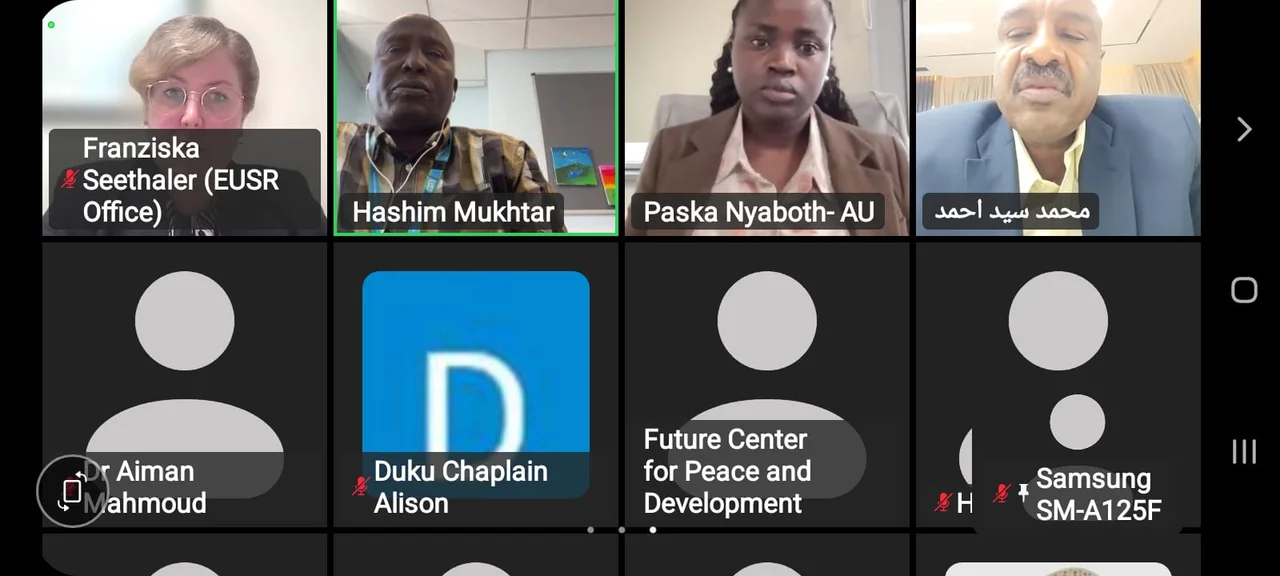
On Monday, the National Forces Coordination held a videoconference meeting with representatives of the five-year mechanism, which discussed a number of issues related to the political process and the Sudanese-Sudanese dialogue, within the framework of consultations aimed at advancing peace efforts and reaching a comprehensive political settlement in Sudan.
During the meeting, representatives of the five-year mechanism presented three main axes, including a coordinating vision for the Sudanese-Sudanese dialogue, and confidence-building mechanisms between the participating parties to ensure the success of the dialogue, in addition to its position on the participation of various parties and forces in the political process.
The delegation stressed that its vision is based on the launch of an inclusive Sudanese-Sudanese dialogue that includes all national, political and community forces without exclusion, considering that the inclusiveness of participation is one of the most important factors for the success of the dialogue and achieving a sustainable national consensus.
The delegation explained that the only exception to this principle includes people who have been convicted of crimes, serious violations or corruption cases, as well as the Rapid Support Militia and the so-called “establishment” as an integral part of it, pointing out that their involvement in the political process represents, according to the vision of the Coordination, a reward for the use of weapons and violence to achieve political goals, and contradicts the principles of justice and the rule of law, and sends negative messages about holding perpetrators accountable.
With regard to confidence-building, the delegation stressed that the success of the dialogue requires the creation of an appropriate political environment, commitment to the principles of justice and accountability, respect for the outcomes of the dialogue, and ensuring the implementation of what is agreed upon, thus enhancing the chances of achieving lasting peace and political stability.
The members of the delegation also discussed the participation of independents in meetings organized by the five-year mechanism, noting that some participants who are presented as independents are in fact affiliated with political parties or parties, which may affect the principle of balanced representation.
The Coordination called for the involvement of genuine independents who are not organizationally or politically linked to any party or party, thus enhancing the credibility of the consultative process and ensuring diversity of views and more impartial representation of different segments of Sudanese society.
It also stressed the importance of ensuring the active participation of genuine stakeholders and communities across Sudan, as key partners in peacemaking and building the future.
For his part, the head of the National Forces Coordination, Mohamed Sayed Ahmed Sir El Khatim, stressed the need to develop appropriate mechanisms to ensure humanitarian access to those affected by the war throughout Sudan, while ensuring that they are not exploited in any hostile acts.
He also stressed that the Sudanese-Sudanese dialogue is concerned with civilian forces, and does not include the military, calling for the separation of the political track and the military track, explaining that the military track is addressed through the decisions of the Jeddah Conference, and that the so-called “establishment” is part of the Rapid Support Militia, and applies to it.
He reiterated his support for peace efforts and adherence to the Sudanese-Sudanese dialogue as the best way to achieve sustainable peace.
During the meeting, the Coordination stressed the importance of achieving real and effective representation of women, youth, displaced persons and refugees, community administrations, community organizations and civil society organizations, reflecting the Sudanese diversity and ensuring that the outputs of the dialogue reflect the various components of society and are able to achieve a comprehensive and sustainable national consensus.
At the end of the meeting, the representatives of the five-year mechanism expressed their thanks and appreciation to the delegation of the Coordination of National Forces, praising its views and proposals, describing the interventions as serious and objective and contributed to enriching the discussion on the issues.
Representatives of the five-year mechanism stressed their keenness to continue dialogue and communication with the coordination of the national forces during the next phase, which contributes to supporting efforts to reach an inclusive political process to achieve peace and stability in Sudan.
The following is the full text of the national forces coordination vision presented by her delegation during the virtual meeting with the five-year mechanism, which included her positions and visions on the Sudanese-Sudanese dialogue, confidence-building mechanisms and issues of participation in the political process.
Vision National Forces Coordination Vision*
About the Preparatory Committee for the Sudanese-Sudanese Dialogue and the Roadmap for Transition
*July 2026*
In the name of God, the Most Gracious, the Most Merciful
▁* Introduction *
The National Forces Coordination puts this vision in the hands of the leaders of the five-year mechanism to resolve the Sudanese crisis as a responsible national contribution, expressing a firm and principled position.
The country has gone through a series of profound political, military and humanitarian crises that have imposed a very complex reality. Recognizing the enormity of these challenges and affirming that effective solutions stem only from pure national will and in support of the aspirations of the Sudanese people for peace and stability, we present this vision.
The Sudanese-Sudanese dialogue, which addresses the roots of the crisis, is the best option to end the war and reach a national consensus that leads to a sustainable peace and a democratic civil state for all.
The Coordination continued to be active in delegations representing the geographical and societal diversity of the Sudanese people: political and national entities, civil administrations, Sufi roads, women, youth, civil society organizations, academics, jurists, displaced persons, refugees, migrants and independents.
Despite the attempts of some forces to abort these efforts through artificial fronts that represent only themselves, we affirm that the solution begins with a pure national dialogue without guardianship.
We submit this proposal to consolidate the Sudanese-Sudanese dialogue as a solid national mechanism capable of building a comprehensive consensus and paving the way for a stable transition that lays the foundations of the state on the foundations of peace, justice, democracy and the rule of law.
First: The Strategic Objectives of the Dialogue
1. End the war, end any armed presence of rebel militias, and restore security and stability.
2. Maintaining the unity and sovereignty of the country and its territorial integrity and rejecting any parallel entities.
3. Investigation Transitional justice, reparations, and impunity.
4. Agree on the arrangements, institutions, tasks and duration of the transitional period.
5. *National reconciliation*, strengthening the social fabric and rebuilding trust.
6. *Establishment of a national economy for the reconstruction and recovery phase.
Second, the governing principles.
1. *Sovereignty and pure national ownership*: Dialogue belongs to the Sudanese people alone without guardianship or external dictates.
2. State unity and the rejection of parallelism: A firm rejection of any governing structures or parallel entities that lead to the fragmentation of the state.
3. Inclusion and non-exclusion: The door is open to all forces that believe in a peaceful solution, clear criteria for participation. With a representation of at least *40% for women and 30% for youth*.
4. Equality and Equal Opportunities: Equal representation of regions, women, youth, displaced people and community administrations. *There is no preferential advantage for any political forces over the other.*
5. Transparency and accountability: To inform the public periodically about the dialogue and its outcomes through weekly press conferences.
6. *Commitment to outputs*: Sign a political declaration before starting and pledge to implement the outputs.
7. *Unity of institutions*: Adherence to the unity and professionalism of the civil and military institutions of the state and non-politicization.
8. The role of the regular forces: Emphasizing the role of the armed forces in protecting sovereignty, while limiting security arrangements to an independent technical path.
9. Rejecting hate speech and the constitutional obligation to respect pluralism.
10. * New reality: War has created a new reality and a new phase that has necessarily copied the previous one.
11. Flexibility: The roadmap or timetable may be amended by consensus of the parties if exceptional circumstances arise that require it, without prejudice to the basic objectives of the dialogue.
12. Linking the outputs to implementation: The outputs of the dialogue are converted into a programme of action for the transitional government, with implementation priorities, responsible parties, and timetables.
*Third: Strict participation criteria*
You are not eligible to participate in any entity that does not meet the following criteria:
1. Non-violence: Strict adherence to civic and democratic means.
2. *Actual representation*: a measurable mass and organizational base, not paper interfaces.
3. *National independence*: not to be associated with external agendas that conflict with higher interests.
4. Integrity: Excluding those involved in war crimes or associated with rebel or divisive militias.
5. * Commitment to the terms of reference*: Signing the transitional constitutional document agreed upon as an umbrella for the transitional period.
6. *Absolute rejection of the participation of the Rapid Support Militia and the so-called “establishment government”* for the following reasons:
– Rapid support is not a political party and does not represent a social base, but an armed force that rebelled against the state.
Their participation legitimizes rebellion and encourages other groups to carry it against the state.
Their participation is a reward for grave violations and betrayal of victims and displaced persons.
– Their participation perpetuates division and contradicts the international and regional consensus rejecting parallel governments and the UN and African Union charters.
Fourth: the structure of the Preparatory Committee and the mechanisms of work
To ensure neutrality and efficiency we propose two structures:
*1. Dialogue Management Committee – 15 members*
It is composed of independent national figures of recognized competence, integrity, neutrality and community acceptance, taking into account equitable geographical representation. It chooses its president unanimously.
*Duration: 3 months non-extendable.*
*2. High Consultative Council for Dialogue*
It includes the heads of the participating entities. Its mission: to adopt the agenda, resolve differences, adopt the final outputs and follow up their implementation.
* Functions and competencies of the Dialogue Management Committee: *
1. *Create the climate*: Release political prisoners, ensure freedoms, build trust.
2. Setting the criteria for representation and its percentage: Adoption of the rule of 50% political and civil forces 50% 50% community components: Civil administration, youth, women, displaced persons, professions.
3. Strict separation of tracks: A civilian political track that is completely separate from the military security track, which is managed according to the Jeddah decisions and technical security arrangements.
4. *Effective participation*: Ensure genuine participation of women and youth in decision-making and the formulation of outputs, not symbolic representation.
5. *Preparation of the National Priority Agenda*:
Ending the War and Security Arrangements
– Inclusive National Pact and Reconciliation
Transition arrangements: election law, party law, federal system
– Reconstruction and economic recovery
– Issues of displaced persons, refugees and transitional justice
– Constitutional Conference and National Identity
6. Adoption of a binding time road map: The duration of the dialogue in Sudan is 6 months, with clear and announced stages.
7. Decision-making mechanism: Unanimous or 75% qualified for critical issues.
8. *Risk Management*: Develop a mechanism to address any differences that may arise during the course of the dialogue to prevent its disruption or the withdrawal of any party.
*5: Binding timetable – 6 months*
▁** Stage ▁** Duration ** Director ** Follow-up **
** 1. Preparation** Month 1 Formation of the Committee, Freedom Release, Adoption of Standards Advisory Board
**2. Thematic Dialogue** Month 2-4 Discussion of 8 priority files agreed upon by the Dialogue Management Committee
**3. Drafting of the Charter** Month 5 Drafting of the National Charter and Transitional Constitutional Document Law Experts ** Committee
**4. Final Conference** Month 6 Signing of outputs and announcement of the Transitional Government Advisory Council ▁Mechanism Five-Year Mechanism
*6: Guarantees of Execution and Accountability*
1. *A binding political declaration* signed by all before the start and deposited with the African Union.
2. * National follow-up mechanism*: Operations room of the Committee ▁Quarter. Advisory Council ▁Quarter. Five-year mechanism to follow up implementation quarterly and publish reports for public opinion.
3. Linking international support to outputs: No funding for reconstruction until after signing and actual implementation.
4. *Arbitration Mechanism*: In case of dispute over implementation, the matter shall be referred to an independent national arbitration body selected by the Advisory Council within 15 days.
5. *Sanctions for obstructionists*: Any party that withdraws without objective justification or obstructs implementation is frozen and officially declared.
▁* Seventh: The role of the international community
Technical and logistical support, environment and resource mobilization, with full respect for Sudanese ownership and leadership and non-interference in outcomes. Their role would be “supportive and facilitator” rather than “sponsor and rapporteur”.
Tham Eight: Conclusion *
The success of the “Sudanese-Sudanese dialogue” depends on sincere national will and concessions in the best interest.
The National Forces Coordination Committee confirms its readiness to participate with high responsibility and a delegation of 12 members that reflects its diversity, based on the principle of equality and equal opportunities.
This vision is not a partisan project but an open national initiative for development and consensus among all Sudanese forces that believe in the unity, sovereignty, peace and stability of Sudan, in order to achieve the aspirations of the Sudanese people in building the state of law, justice and democracy.
The country cannot afford any more delays. A historic consensus among the Sudanese people is necessary.
National Forces Coordination
July 2026.