
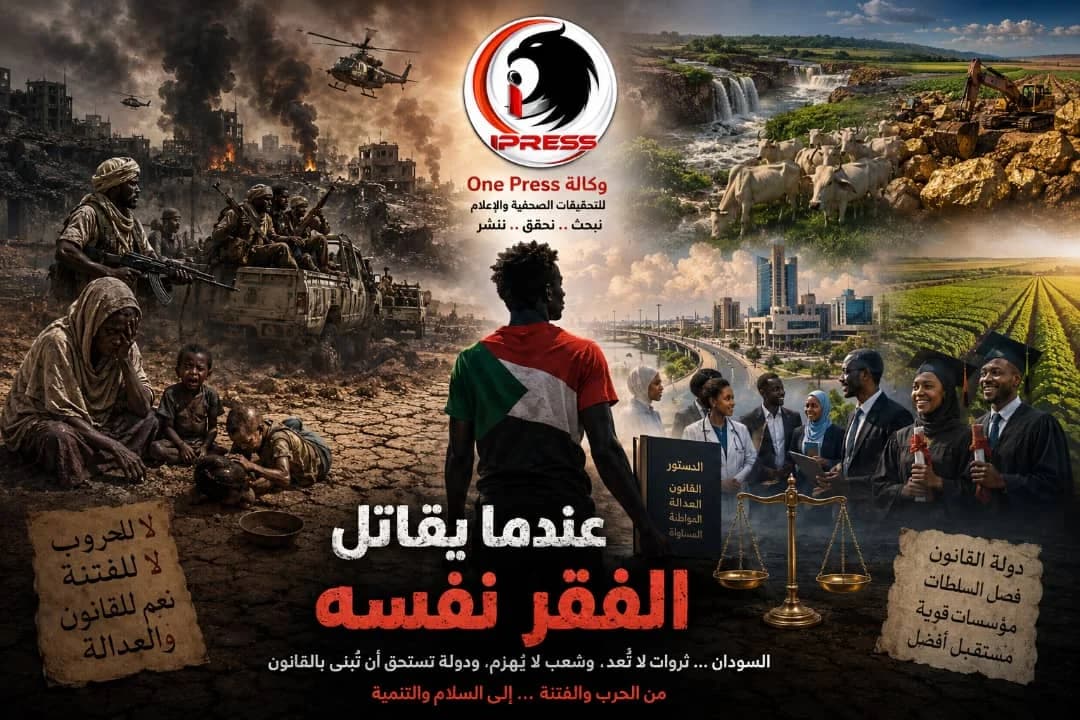
Port Sudan _ OnePress
“In this world, there are countries that are looking for water, and Sudan is drowning in water.
There are people dying for a tree... and Sudan is wasting forests with fire and neglect.
There are nations that import food with terrifying budgets... whereas in Sudan, if a grain of wheat had been thrown in, a whole continent would have sprouted.
A country over which rivers flow like arteries, and the sky rains without permission, and beneath which minerals of gold, copper, iron, uranium, sand, and riches are still in the belly of the earth as if it were a deferred curse.
Animal wealth is unknown, and clean water in many areas requires no purification plants, no treatment networks, and no complex chemistry.
But this vast country was stretched between helpless arms and more helpless minds.
The scene became a mixture of war, disease, poverty, displacement, the smell of gunpowder, smoke and blood that covered the grace of the earth itself.
These days I visit Rwanda.
A country that came out of mass graves, from the screams of Hutus and Tutsis, and from the blood that flowed until the world thought that this country would never exist again.
But the Rwandans understood something that we have not yet understood:
That the earth does not live by speeches... but by laws.
A law that governs people fairly, and a law that governs the state with institutions.
In Kigali, cleanliness is seen as a faith, and discipline as a part of national identity.
The cop doesn't scream, the employee doesn't blackmail you, and the street doesn't chase you with chaos.
An entire people has decided to bury the hatred so that their children will never be buried again.
There they realized that if the tribe entered the state they ate it, and that if the power turned into booty the country turned into an open graveyard.
Rwandans have built their country with determination, action, discipline and respect for institutions, not with cheap allegiances, nor with political brokers, nor with the rhetoric of sedition.
As for Sudan, the wars in it did not start with a rifle... but began from the fragility of the state itself.
From a confused constitution, weak institutions, and an authority that does not separate the state from the government, nor between law and temperament, nor between administration and loyalty.
Everything we have is politicized, tribal, and negotiable.
That is why any small disagreement turns into war, any local conflict into sedition, and any economic crisis into blood.
A state that does not rule by law ends up being ruled by arms.
Power that fails to build respectable institutions opens the way for warlords, blood traders and brokers of division.
One of the worst disasters in Sudan is that institutions created in the name of resources have become instruments of collection rather than instruments of regulation.
The Sudanese Mineral Resources Company is an example of this.
An institution that has expanded to collect more money than to protect the environment, man or the earth.
It has opened up traditional mining without real controls, leaving carbon, mercury and cyanide to mess with soil, water and humans in northern, eastern and western Sudan.
Whole mountains turned into poisonous holes, and valleys became slow graves for people and animals.
No respectable technical standards, no real environmental oversight, no country asking what will happen in ten years to this exhausted land.
God’s curse is on those who sow discord among the components of this poor people.
But it is also the fact that the authorities that levy unjustly, and the governments that fail to enforce the law, are the same ones that are helping to tear apart the social fabric.
In eastern Sudan today, congestion is widening due to traditional mining, chaos brought on by quick money, weapons and the complete absence of the state.
The attack of some miners on an unarmed citizen of the East is not a separate incident, but the natural result of an absent state and confused institutions and authorities that see in the citizen only a fee-paying or a number in the collection book.
When there is no justice, people begin to take refuge in the tribe, and when the prestige of the law collapses, society turns into camps of rage, waiting only for the spark.
The government of Kamil Idris is dancing today over the fires of sedition that are eating up the outskirts of the country.
Desperately engineered by a political and administrative naked consultant, he makes contradictory decisions as if playing chess over the corpse of a state.
He enters his hand into every institution, collects contradictions, and engages in the hobby of tampering between powers, until no one knows where the state begins and personal moods end.
This kind of management doesn't build a nation... it builds a deferred mess.
The state is not run by parade or public relations or by speeches made in front of cameras, but by minds that know the meaning of separation of powers, respect for institutions, and building a law that governs everyone.
Wood Keen once said:
“The country that is bereaved is gone... what you ask for is pain.”
Another poet said:
“The trees broke and fell.
“O people of Raso, tie him up as a shepherd.”
That is exactly what we have been doing for decades.
We treat the symptoms, we leave the disease, we chase the results, we protect the causes, we change the faces, we keep the ruins the same.
“This state must seek a man who runs the civil state by law, not by clownism, by institutions, not by temperament, by the separation of powers, not by combining them into one hand.
Kamel Idris, in our estimation, is no more than a political clown who is not fit to manage this ruin, let alone fix it.
And the country where poverty fights itself... needs statesmen, not amateurs standing on the ashes and clapping for fire.
Awadullah Nowai – Director of OnePress