
Khartoum OnePress
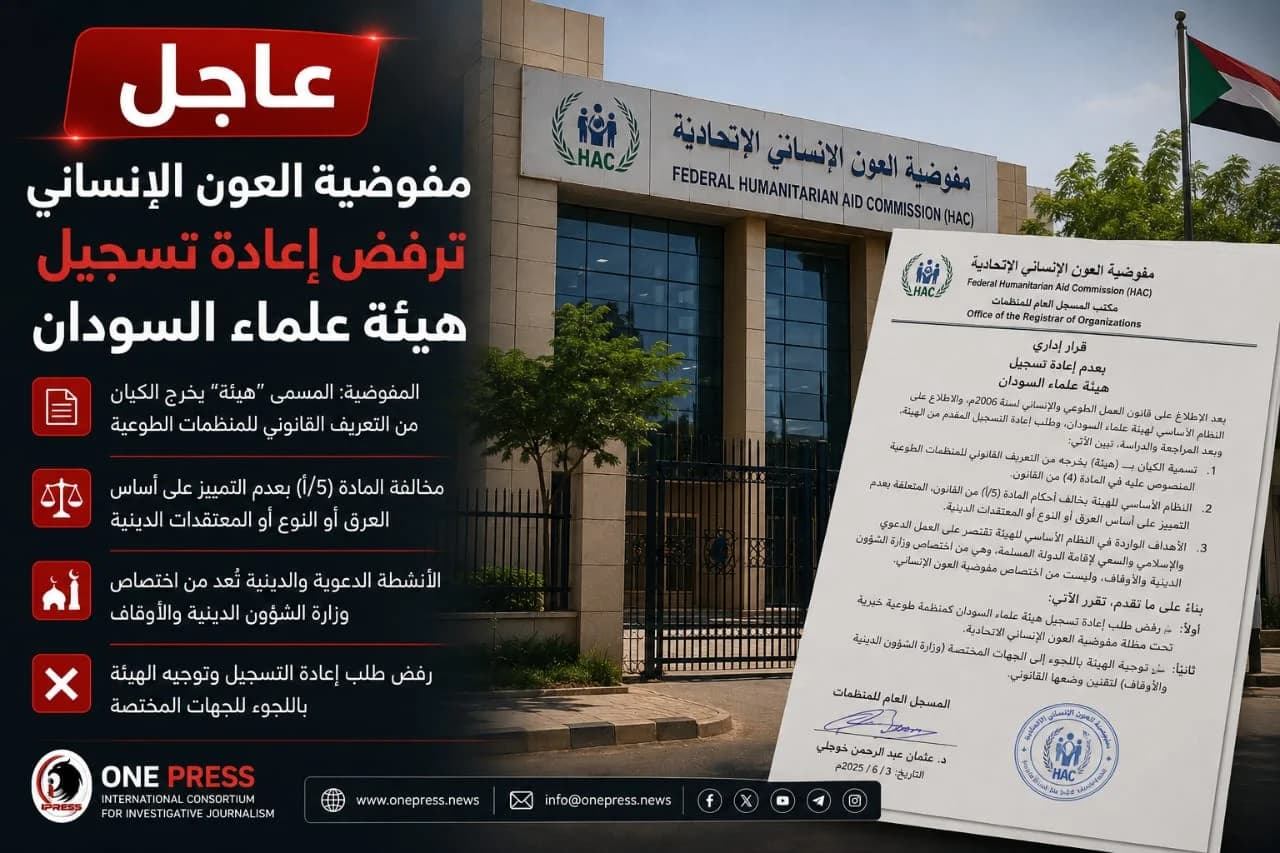
In a remarkable legal move, the Federal Humanitarian Aid Commission issued a decision to refuse to re-register the Sudan Scholars Association as a voluntary charitable organization, in a decision that is expected to provoke a wide debate within the religious and legal communities in Sudan.
According to the decision issued by the Registrar General of the organizations of the Humanitarian Aid Commission, Dr. Othman Abdul Rahman Khojaly, the review of the statute of the Commission showed that there were direct conflicts with the provisions of the Voluntary and Humanitarian Work Law of 2006, which prevented the approval of re-registration under the umbrella of the Commission.
The decision pointed out that the designation of the entity as a "body" is not in line with the legal definition of voluntary organizations provided in Article (4) of the law, considering that the name exits the entity from the specific regulatory framework of humanitarian and charitable organizations.
The Commission also explained that the statute of the Commission includes objectives of a Dawa and religious nature, including Islamic work and the pursuit of the establishment of the Muslim state, which the Commission considered an activity within the competence of the Ministry of Religious Affairs and Endowments, and not within the scope of humanitarian voluntary organizations.
The decision accused the commission of violating Article 5(a) of the law, relating to non-discrimination on the basis of race, gender or religious beliefs, considering that the nature of the objectives contained in the statute does not comply with the legal standards governing voluntary work.
Accordingly, the Humanitarian Aid Commission decided to reject the request for re-registration, directing the Authority to resort to the competent authorities to legalize its legal status, in reference to the Ministry of Religious Affairs and Endowments.
The decision is expected to open a wide-ranging debate over the boundaries between advocacy and voluntary work, and the nature of the legal framework governing religious institutions in Sudan in the coming period.